

Though great institutional investors should never be reactionary, their success still depends on how well they can identify market trends and the opportunities they present.
In 2025, those who quickly understood the fiscal policy uncertainty of Trump’s tariff policy made money investing in commodities like gold, silver, and crude oil. And those who remained invested in the equities market took advantage of international financial markets like Japan and India.
As we head into 2026, smart institutional investors are already positioning themselves for the macro and micro factors that would likely shape the global investment space.
In this article, we will consider the best investment strategies for 2026 that will help institutional investors take advantage of the trends that promise to shape the global economy.
We’ll cover:
- Global diversification
- Strategic thematic investing
- Barbell equity approach
- Alternative investing
- Inflation-hedging
- Intermediate-term bonds
- Geopolitical risk management
- Liquidity management
Do you want to learn more about how global trends should affect your investment decisions? Subscribe today for the cio investment club’s newsletter.
1. Global diversification
In 2025, Trump’s tariffs, monetary policy uncertainty, a falling dollar, and a selloff of US Treasury securities all contributed to a renewed interest in international equities. The interest was so strong that international equities are on course to outperform US equities.
Monetary policy uncertainty persists. In late October 2025, there was a 98% probability of a rate cut in the US in December, according to The Private Office, a United Kingdom-based financial firm. This fell to 40% by mid-November before rising to 80% at the end of November.
The swings in the probability reinforce the debate about whether another rate cut is necessary or desired.
Many (including the US President) want a lower rate to boost GDP growth, while others are concerned about the inflationary effects of a rate cut, especially since such a cut does not seem necessary based on current economic data.
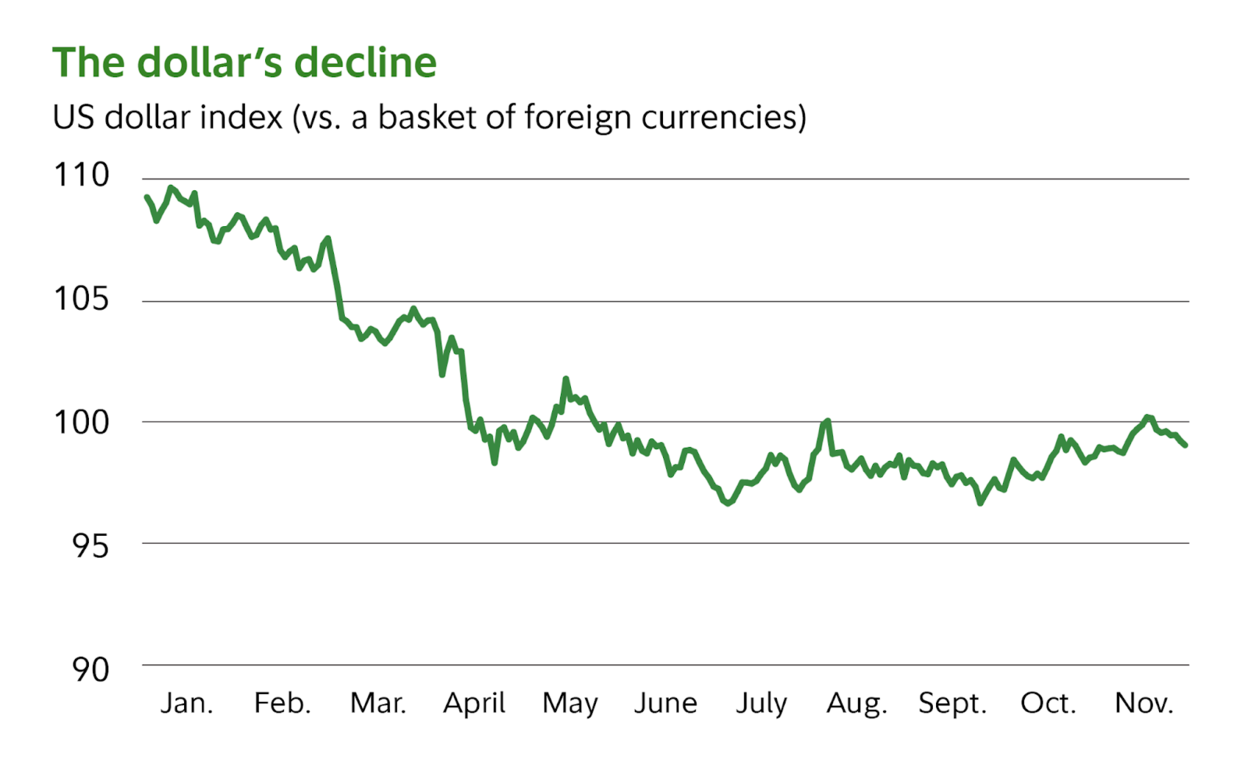
Also, though the dollar will likely maintain its position as the world’s reserve currency, its dominance continues to be weakened. The dollar as a share of global reserves declined from 65% in 2016 to 57% in 2024, according to The Private Office’s study of the International Monetary Fund’s data. Also, the chart below shows how the dollar has declined relative to an index of other currencies:
USD Versus a Basket of Foreign Currencies
Source: Fidelity Investments
Furthermore, many analysts and strategists have pointed to the risk of the concentration of US equities in a few mega tech stocks. At the end of Q3, 2025, eight of the largest American companies constituted 36.1% of the index value, according to the MSCI USA Index.
“For globally minded investors, this is more than a warning sign,” according to Dan McKellar, CFA, a Senior Vice President at Bailard Inc., a wealth management firm. “It's an opening. Developed markets outside the U.S. offer lower valuations, more balanced sector leadership and less reliance on a few dominant names.”
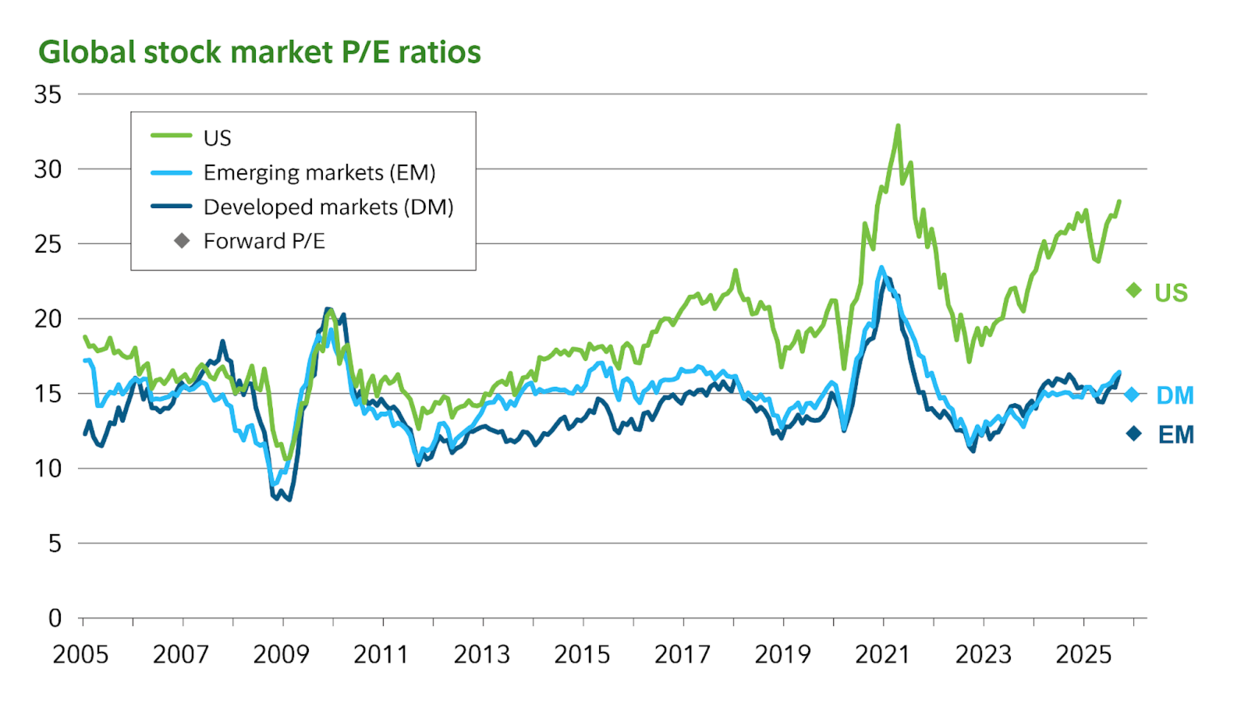
As seen below, indices of emerging markets and developed markets stocks have a lower P/E ratio compared to the US stock market. More importantly, the valuation gap has been increasing in recent years.
Source: Fidelity Investments
Moreover, many developed and emerging economies continue to look attractive on metrics that matter to institutional investors.
The rising middle class in India is driving domestic consumption, corporate reforms are putting Japan’s companies on the global map, and Southeast Asian countries are benefiting from global supply chain diversification, among other examples provided by Landsberg Bennett, a private wealth management firm.
International diversification should be the priority of institutional investors in 2026, especially those overweighted in the US market. This is a good way to reduce risk as well as increase returns.
2. Strategic thematic investing
Many analysts have expressed concerns that we may be in an artificial intelligence (AI) bubble. This is due primarily to the high valuation of many unprofitable AI companies.
However, we have seen that instead of ignoring AI, which has become the dominant global trend, investors should explore investment strategies that can help them take advantage of the opportunities while minimising the risk.
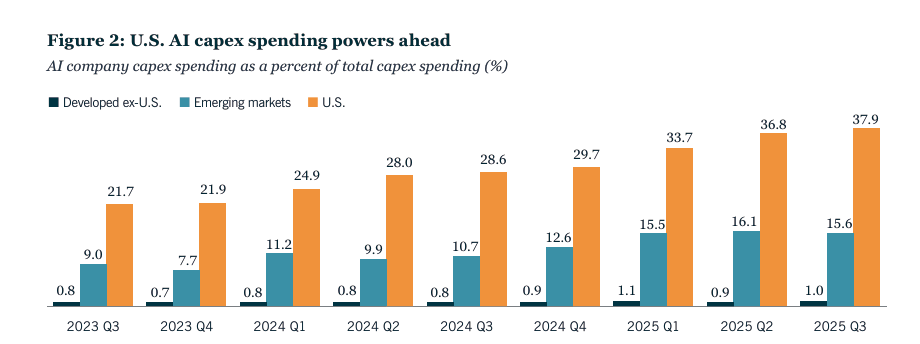
“U.S. megacap tech companies may have less-than-clear monetisation timelines around some aspects of AI profitability, but we think investors will continue to reward AI-related capex spending, which shows no sign of slowing down in the U.S,” according to Nuveen Investments, an investment management firm.
AI Capex as a % of Total Capex Spending in Different Markets
Source: Nuveen Investments
Some of these strategies include:
First, focus on fundamentals when investing in AI companies or funds. When the AI bubble bursts, many companies with inflated valuations will suffer, but those that are fundamentally sound will remain.
Instead of avoiding AI, institutional investors will focus on those with real revenue, a scalable business model, product-market fit, and profitability.
Second, investors should approach AI as a multi-decade opportunity with the potential for real-world impacts. Any attempt to embrace AI as a quick fad that can provide some quick bucks will only amplify risk exposure and likely lead to capital loss.
Third, investors should strike a balance between well-established hyperscalers (strong cash flows but small growth potential) and AI startups (high growth potential and high risk). In the middle are fundamentally sound companies building AI-driven software solutions in particular industries.
Beyond AI, institutional investors should also pay attention to both energy and healthcare, according to Nasdaq.
For the former, they believe increased energy demand from data centres (the powerhouse of the AI revolution) will spur greater interest in both renewable energy sources like solar and wind and more traditional sources like natural gas and nuclear energy.
On the other hand, the interest in the healthcare sector would be driven by an interest in defensive sectors, as volatility continues to be an issue.
“Furthermore, 2026 is expected to be a strong year for mergers and acquisitions (M&A) in this space,” they noted. “Large pharmaceutical companies facing patent expirations are cash-rich and looking to buy smaller biotech innovators to replenish their pipelines. This combination of defence, high-growth innovation, and M&A potential creates a profile known as Growth at a Reasonable Price (GARP).”
To summarise, institutional investors can position themselves to profit from trends that are poised to keep becoming globally relevant in 2026 and beyond.
3. Barbell equity approach
What Nasdaq said about the interest in the healthcare sector as a defensive strategy leads us to one of the best investment strategies for 2026: a barbell equity approach.
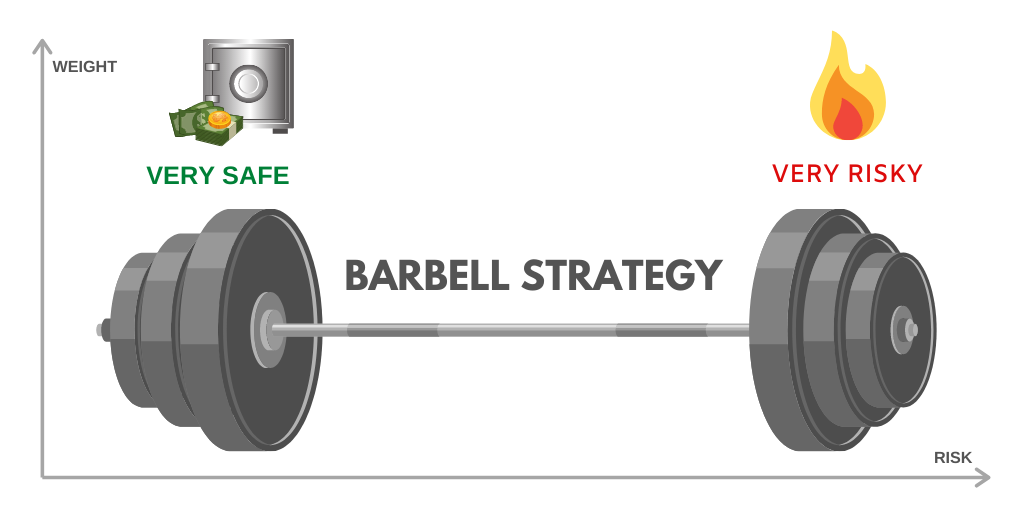
This is an approach that involves blending growth-oriented assets (very risky) with purely defensive plays (very safe) in an attempt to balance volatility and avoid the middle ground.
The barbell approach
Source: Quantilia
Such an approach remains one of the best ways to navigate the current global equity market, according to Nuveen Investments.
“Despite recent tech-related market jitters, AI/tech dominance will likely persist,” they noted. “But we also think it makes sense to balance that with allocations offering potential resilience to downturns, inflation protection and/or stable growth such as infrastructure and dividend-growing companies.”
To summarise, while pursuing high-growth themes, institutional investors should also seek low-risk or safe assets (investment-grade bonds, defensive stocks, and dividend stocks, etc) to protect their portfolios.
4. Alternatives investing
Alternatives, especially securitised credit and gold and silver investments, played an important role in investors’ portfolios in 2025.
Given that the factors that drove interest in alternatives in 2025 remain (macroeconomic uncertainty, the search for higher returns, the demand for a resilient portfolio, etc.), we expect alternatives to play a crucial role in 2026 and beyond.
So, what are alternative investment strategies for 2026?
Duration risk and credit spread tightening remain headwinds for the global fixed-income market. However, private fixed-income markets continue to open up opportunities to enhance returns, income, and diversification, according to Nuveen Investments.
“We encourage investors to seek out alternative credit sectors beyond traditional fixed income benchmarks, including senior loans, collateralised loan obligations, public and private securitised assets, real estate and infrastructure debt and Commercial Property Assessed Clean Energy (C-PACE) financing,” they advised.
Similarly, they believe lower interest rates can increase M&A activities, spurring private equity.
The need for sustainable income, genuine diversification, and access to relevant growth themes reshaping the global economy will drive the interest in alternatives in 2026, according to State Street Investment Management, a financial services firm.
They recommend that investors focus on private credit, real assets, infrastructure, private equity, and select hedge fund strategies. Many institutional investors are also becoming more amenable to cryptocurrencies like bitcoin as part of the alternatives universe.
Regarding real assets, they highlighted the impact of gold in 2025 and how macroeconomic conditions will continue to affirm its importance going forward.
“Gold continues to benefit from macroeconomic uncertainty, fiscal activism, and elevated global debt levels,” they noted. “In this environment, gold serves as a strategic hedge against debt monetisation and currency debasement.”
5. Inflation hedging
Both fiscal and monetary policy uncertainty are reinforcing inflation fears amongst institutional investors.
About 40% of respondents now see reinflation as a key risk, up from 30% leading up to 2025, according to a survey by Natix Investment Managers, an investment management firm. Also, inflation was the second most feared portfolio risk (behind valuation risk).
The fact that inflation is above 2% in most developed economies (only the European Central Bank has achieved a 2% target), even while monetary policy remains accommodative, makes inflationary growth the most likely scenario for 2026, according to Wellington Management, an investment management firm. This possibility is reinforced by protectionist policies and China’s decision to remove capacity in many sectors.
“If AI-driven productivity growth fails to materialise, conditions are ripe for an inflationary boom in 2026, with policy stoking stronger demand amid weaker supply,” they noted.
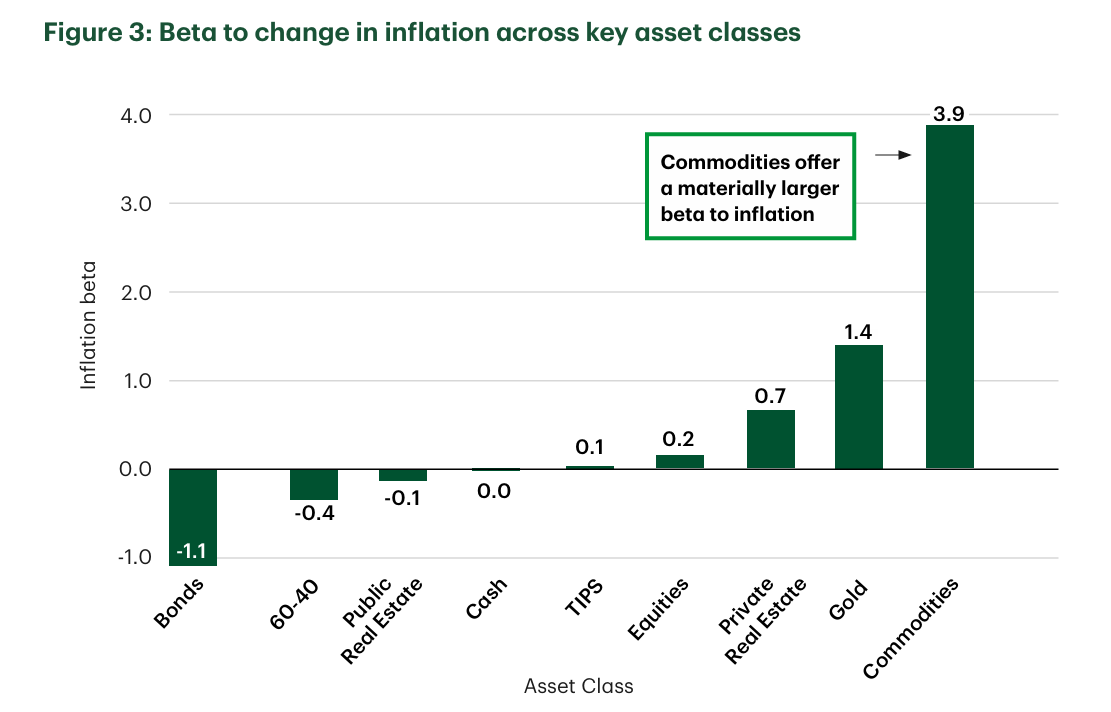
In this environment, commodities and real assets like gold, silver, and crude oil can shine the brightest. As the chart below shows, gold and other commodities are the asset classes with the highest beta to changes in inflation:
Source: TD Asset Management
Also, monetary accommodation can lead to asset price inflation, lifting equities and containing credit spreads.
However, there is always the risk that such price levels may be unsustainable.
“Finally, asset price inflation concerns reflect institutional investors’ awareness that prolonged monetary policy accommodation has elevated asset prices,” according to Titan Funding, a private money lending firm. “Their institutional investor strategies increasingly consider the risk that these price levels may not be sustainable if economic conditions change or if policy normalisation accelerates.”
This implies that institutional investors have to pay more attention to fundamentals and ensure that they are not overpaying for overvalued assets. It will also mean increasing cash reserves and shifting towards defensive sectors in anticipation of a policy normalisation.
To summarise, inflation remains a credible threat, and institutional investors must prepare for a possible higher inflation and a boom and bust cycle that might follow monetary policy changes.
6. Intermediate-term bonds
Though most analysts still expect lower interest rates in most developed economies, we have seen that inflation concerns make the interest rate path uncertain.
Given this scenario, intermediate-term bonds (corporate and government bonds) may offer a sweet spot in the coming year (2026).
On the one hand, since the primary expectation is lower rates, intermediate bonds can offer high yield (better than short-term bonds) and even benefit from potential capital gains if rates continue to decline.
On the other hand, long-term bonds have higher duration risk and can become vulnerable if inflation resurges.
“I believe bonds with maturities of around 5 years are a sweet spot because they’re somewhat insulated from the volatility you might see in both shorter and longer maturities,” according to Jerome Schneider, the head of Short-term Portfolio Management and Funding at PIMCO, a fixed-income management firm.
According to him, if the Federal Reserve goes ahead with interest rate cuts, the yields of short-term bonds would fall. Also, the prices of long-term bonds are volatile because investors are cautious about the US government’s ability to manage debt.
This leaves intermediate-term bonds as the best financial instruments to manage both yield and volatility in the bond market.
7. Geopolitical risk management
About 45% of US institutional investors see geopolitical disruption as their top fear going into 2026, according to the survey by Natix Investment Managers, quoted above. About 58% expressed worries about conflict in the South China Sea, while 65% see China’s dominance of rare earth as an energy security risk.
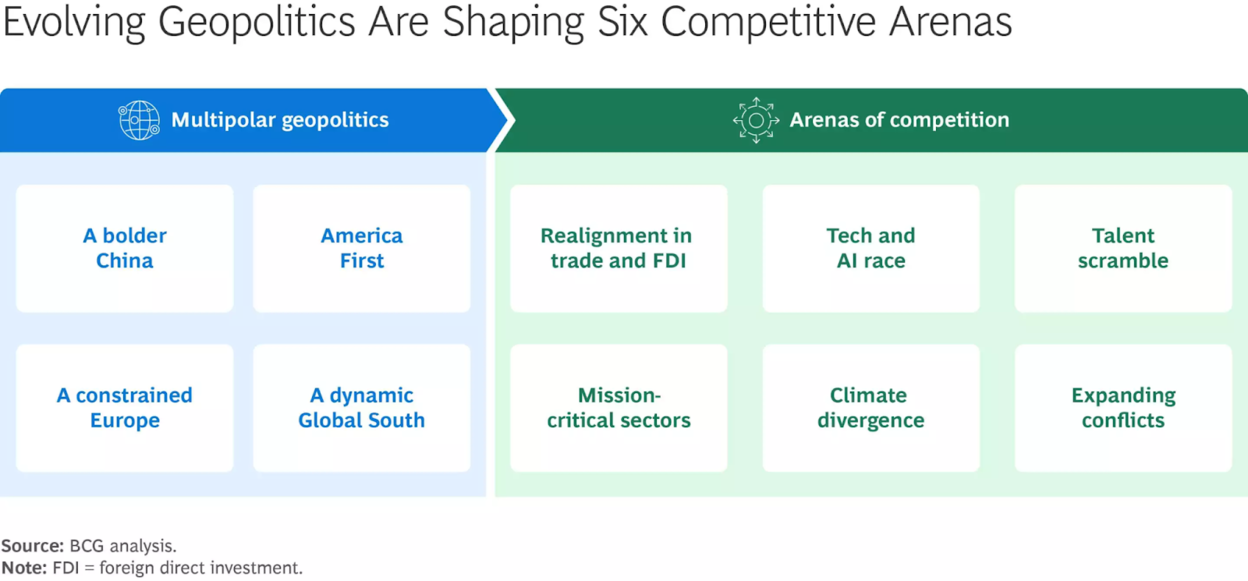
The four multipolar geopolitics are a bolder China, America first, a constrained Europe, and a dynamic global South, according to Boston Consulting Group (BCG), a management consulting firm. The interactions between these are shaping six competitive arenas: realignment in trade and FDI, tech and the AI race, talent scramble, mission-critical sectors, climate divergence, and expanding conflicts.
Source: BCG
Institutional investors must understand that geopolitical risk extends beyond regional conflicts and must design risk management strategies in line with this more comprehensive understanding.
The best investment strategies for 2026 to manage geopolitical risk include global diversification, inflation and currency hedging, supply chain and trade risk hedging (investing in companies with diversified supply chains), stress testing and scenario planning, incorporation of ESG standards, allocation to commodities and other alternatives, and incorporation of geostrategic intelligence into investment research.
8. Liquidity management
About 74% of global institutional investors surveyed by Natix Investment Managers forecast that the financial markets are due for a correction next year (2026).
“The outlook for 2026 is clouded for institutional investors,” according to Dave Goodsell, Executive Director of the Natixis Centre for Investor Insight. “After years of strong returns, risks that once felt distant are more tangible. With uncertainty surrounding geopolitics, growth, and inflation, investors are positioning portfolios to weather whatever conditions 2026 may bring.”
In such volatile and uncertain markets, one of the best investment strategies for 2026 is to have a cash reserve or buffer. If the expected correction materialises, it will offer opportunities for institutional investors to pick up quality assets at discounted prices.
Also, as we have seen above, monetary policy accommodation could lead to asset price inflation (boom) followed by a bust as policy normalises due to inflationary concerns. If such a boom-bust cycle becomes a reality, institutional investors with a cash buffer can snatch up quality assets at discounted prices.
Institutional investors who have paid attention to the investment lessons of 2025 understand the importance of keeping a close tab on developments in the global macroeconomy and the capital markets.
At cio investment club, we provide you with a network of asset managers, asset owners, and other investment experts with whom you can exchange ideas and share investment opportunities.
We also organise exclusive roundtables and investment breakfasts where you can network with like-minded professionals from across the globe.
Do you want to be part of an investment community that will help you better take advantage of global trends? Register today to be a part of the cio investment club.
Takeaways
- Concentration risk in US equities and dollar uncertainty make international markets central to 2026 strategies.
- AI, energy, and healthcare remain powerful themes, but fundamentals and long-term positioning matter more than hype.
- A barbell equity approach (combining high-growth themes with defensive assets) helps manage volatility in uncertain markets.
- Cash buffers, real assets, and intermediate-term bonds position investors to navigate corrections and inflationary shocks.
Disclaimer:
This document is produced by Instaconnect Limited, trading as cio investment club, a company registered in England & Wales with registration number 15262951.
Instaconnect Limited is neither authorised nor regulated by the Financial Conduct Authority in the United Kingdom nor the Securities and Exchange Commission in the United States of America.
This document is a marketing documentation and is not intended to constitute an invitation or an inducement to engage in any investment activity. It is not intended to constitute investment advice and should not be relied upon as such. It is not intended and none of Instaconnect Limited, its holding companies or any of its or their associates, or any of the participants in the documentation, shall have any liability whatsoever for (a) investment advice; (b) a recommendation to enter into any transaction or strategy; (c) advice that a transaction or strategy is suitable or appropriate; (d) the primary basis for any investment decision; (e) a representation, warranty, guarantee with respect to the legal, accounting, tax or other implications of any transaction or strategy; or (f) to cause Instaconnect Limited to be an advisor or fiduciary of any recipient of this report or other third party.
The content and graphical illustrations contained in this document are provided for information purposes and should not be relied upon to form any investment decisions or to predict future performance. Instaconnect Limited recommends that recipients seek appropriate professional advice before making any investment decision. Although the information expressed is provided in good faith, Instaconnect Limited does not represent, warrant or guarantee that such information is accurate, complete or appropriate for your purposes and none of them shall be responsible for or have any liability to you for losses or damages (whether consequential, incidental or otherwise) arising in any way for errors or omissions in, or the use of or reliance upon the information contained in this document.
To the greatest extent permitted by law, we exclude all conditions and warranties that might otherwise be implied by law with respect to the document, whether by operation of law, statute or otherwise, including as to their accuracy, completeness, or fitness for purpose.
Instaconnect Limited and its logo are proprietary trademarks of Instaconnect Limited and are registered in the United Kingdom. Unauthorised copying of this document is prohibited.
© Copyright Instaconnect Limited 2025