
Gone are the days when economists and other analysts believed that financial markets are efficient, driven purely by human rationality.
Behavioural finance has taught us over the past decades that investor psychology, cognitive biases, and emotional biases influence decision-making and market movements. This is why market conditions like bubbles, crashes, and mispricing arise.
Fear (leading to panic selling) and greed (leading to speculative buying) are two of the most common emotional biases that drive market cycles. Even professional investors who understand that fundamental factors drive long-term value remain captive to the fear-and-greed cycle.
Geopolitical tensions in the Middle East, the growing popularity of AI, the fall of the dollar, the performance of non-US equity markets, and the crypto market crash are recent phenomena that are producing fear and greed among some institutional investors.
In this article, we consider why investors should embrace a long-term investing strategy that focuses on fundamentals instead of being driven here and there by the winds of current market sentiment.
We’ll cover:
- The problems with the fear-and-greed cycle
- Overview of current phenomena causing fear and greed
- Beyond fear and greed: Embracing disciplined investing in the current market
Do you want to learn more about how to take advantage of current market sentiments? Subscribe now to cio investment club’s newsletter for regular updates about the financial markets.
1. The problems with the fear-and-greed cycle
The fear-and-greed cycle is a concept that has always been popular on Wall Street. It was popularised by Warren Buffett when he advised that investors should be fearful when others are greedy and greedy when others are fearful.
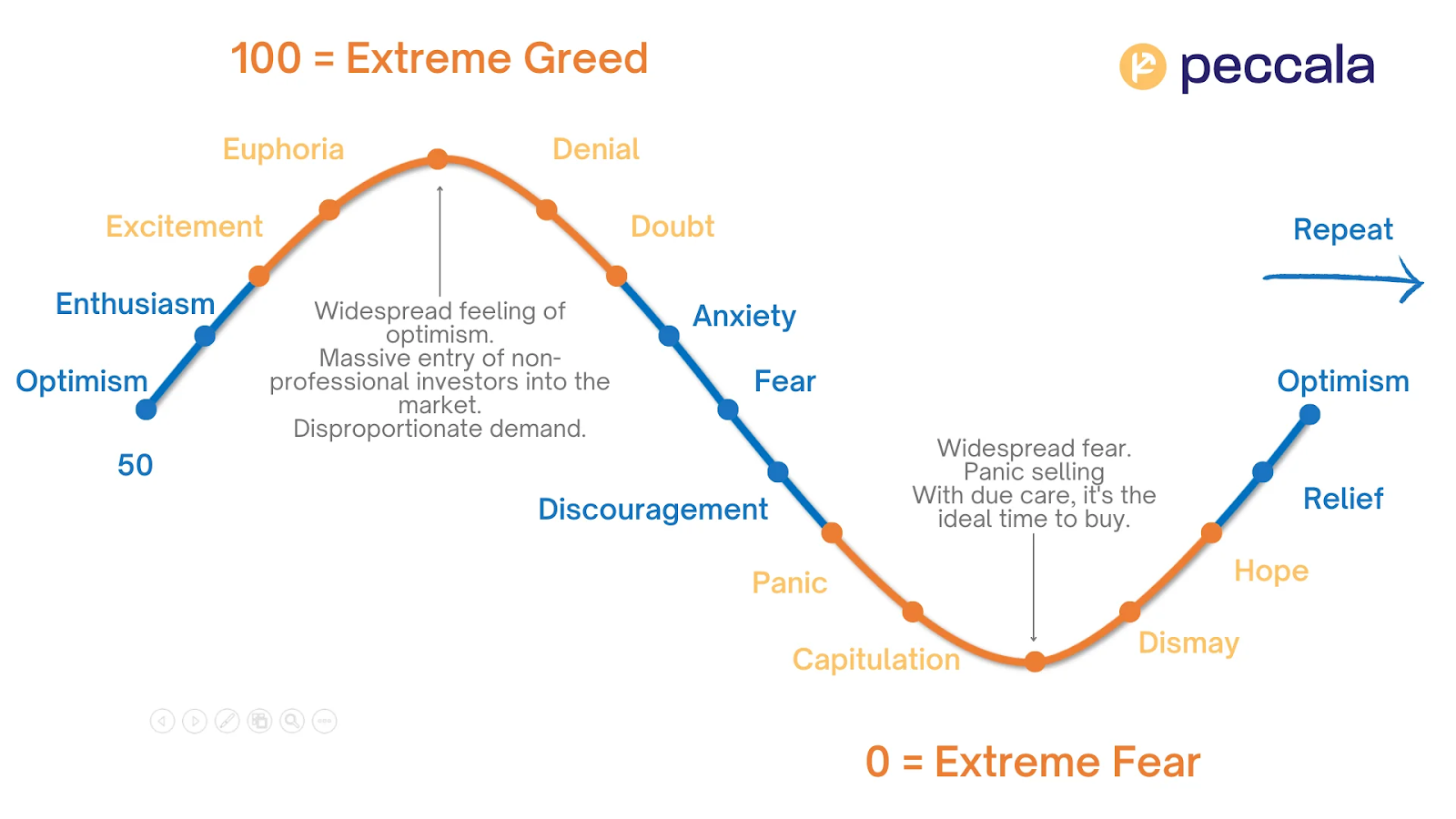
Though it is called the fear-and-greed cycle, it often begins with greed.
Investors see opportunities in the market, and they start buying. At first, the buying may be justified by certain fundamentals even as the price continues to rise.
However, valuations soon detach from fundamentals, but money keeps pouring in since no one wants to miss out on the next best thing (fear of missing out, FOMO).
At this stage, euphoria has set in, and a bubble is formed
After a while, the rubber meets the road, and warning signals arise. Investors downplay these warning signals at first until they intensify and reality dawns on them.
Greed then gives way to fear, and everyone starts trying to rush out of the market. As market participants overreact, selling pressure rises, liquidity dries up, and the market crashes.
Below is a visual demonstration of this cycle in its finer details:
The Fear-and-Greed Cycle
Source: Peccala
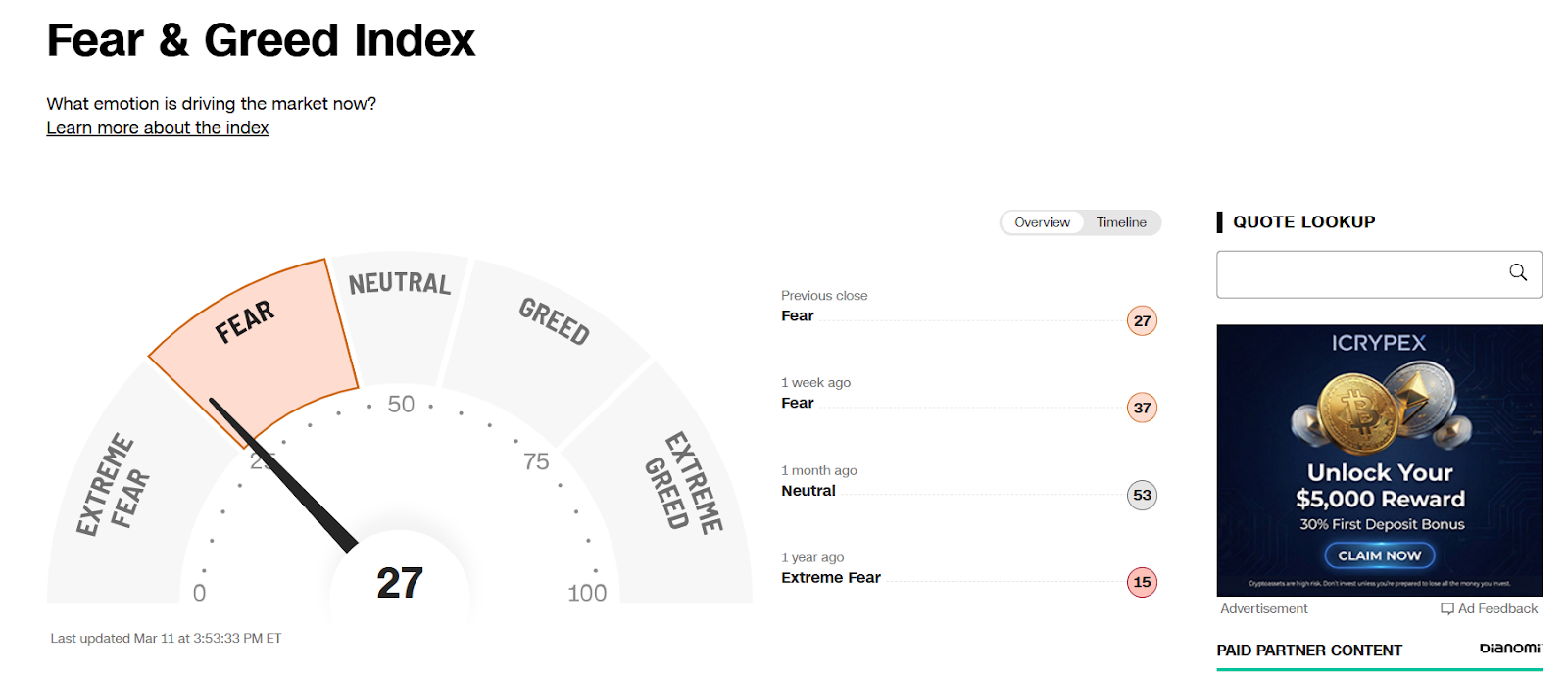
CNN has a Fear and Greed Index with which they track market sentiment. They consider factors like market momentum, stock price strength, stock price breadth, put and call options, junk bond demand, market volatility, and safe haven demand when calculating this index.
It ranges from 0 to 100, with 0-25 indicating extreme fear and 75-100 indicating extreme greed. The index was near 0 during the 2008 financial crisis and near 90 during the 2021 crypto boom, according to Anandi Patel, founder of the Mind Money Markets blog.
At the time of writing, the index is at 26, as seen below, just a little above the extreme fear level.
CNN Business Fear and Greed Index
Source: CNN Business
The fear-and-greed cycle in history
The dot-com bubble (1999-2000) is a standard example of the fear-and-greed cycle.
Investors poured money into the IPOs of internet companies with little or no profits, confident that the internet was the next big thing. The initial buying pressure led to rising prices, and everyone wanted a bite, motivated by the belief that the only way is up.
During this bull market (1995-2000), the tech-driven NASDAQ went up by 400%.
However, the index peaked by March 10, 2000, as the gap between valuations and fundamentals led to anxiety in the market. A bear market followed, and by October 2002, the index had lost about 78% of its value, as euphoria gave way to fear and panic.
The global financial crisis in 2008 is another example.
Excitement and optimism led many financial institutions to chase higher returns by issuing subprime mortgages and then securitising them into investment assets sold to the public. Even rating agencies gave high grades to many of these toxic assets, leading to more speculation.
By 2007, mortgage defaults were rising, leading to anxiety. Many were still in denial, though, until the collapse of Lehman Brothers in 2008. Panic selling resulted, and the S&P 500 Index was down by over 50% from its previous peak.
The fear-and-greed cycle also manifested during COVID-19, though this time it was fear preceding greed. Fears of a global economic shutdown caused the S&P 500 Index to drop by 34% in just 33 days.
However, by 2021, fear gave way to greed due to low interest rates, massive stimulus checks, and speculation among retail investors. This resulted in a rapid rise in the prices of many technology and meme stocks.
Euphoria set in by late 2021 with many markets hitting new all-time highs (ATHs).
Fear would then result when inflation surged, and central banks had to increase interest rates. Overvalued tech stocks and cryptocurrencies fell as panic gripped the market.
Consequences of the fear-and-greed cycle
Wealth destruction
By the time the investor sentiment shifts towards greed and euphoria, the asset of concern has already gone up by some significant percentage points.
Those who enter the market at this time, due primarily to herding behaviour, are not catching the asset at its bottom. In fact, they are more likely to be buying close to the peak of the current cycle, though they can’t know it at the time.
By the time anxiety, fear, and panic take over, the asset of concern goes on a heavy downturn. Usually, the asset settles at a price below the entry price of most of those who followed the crowd and fell to the allure of market euphoria.
In other words, the fear-and-greed cycle leads many investors to lose money on promises that don’t materialise, while they struggle to achieve their financial goals.
“The average man tends to buy high and sell low,” said Ray Dalio. They buy high close to the peak of the market cycle and sell low close to the bottom of the cycle. And nothing better illustrates this situation than the fear-and-greed cycle.
Inefficient capital allocation
Since resources are limited, using them for any particular purpose incurs an opportunity cost.
When investors pile resources into an asset or asset class, even when fundamentals don’t justify such decisions, the opportunity costs are other productive investments they could have made.
The money lost due to the boom-bust cycles could have built wealth in some other assets or asset classes where there were real opportunities to generate long-term returns.
Economic losses
Boom-bust cycles don’t just result in financial losses to investors; they can have economic-wide impacts that cause everyone to suffer.
There was a mild recession in 2001, following the burst of the dot-com bubble, with many job losses in the tech sector.
The contagion effect of the housing collapse in the US led to a global recession in 2008/2009, even as US unemployment peaked at 10%.
Fear and panic caused global GDP to shrink in 2020, while greed and euphoria resulted in rising inflation, which also led to higher interest rates and a liquidity crunch in many real sectors.
Market distrust
All these boom-bust cycles reduce the trust of many in financial institutions.
This manifests as a rejection of any financial innovation, a preference for real assets over financial assets, conspiracy theories about banks, continuous demand for tighter regulations, and a communist awakening.
2. Overview of current phenomena causing fear and greed
We are living at a time when many things are happening all at once. Some of these have the potential to spur fear or greed and cause a fear-greed cycle that will harm investors and the general populace.
Below are the most relevant ones:
The AI bubble
Analysts have been sounding concerns about the AI bubble that is currently developing.
Top technology companies continue to fight for AI supremacy, even as AI companies continue to dominate venture capital funding across the globe. FOMO is leading to a massive investment in this technology.
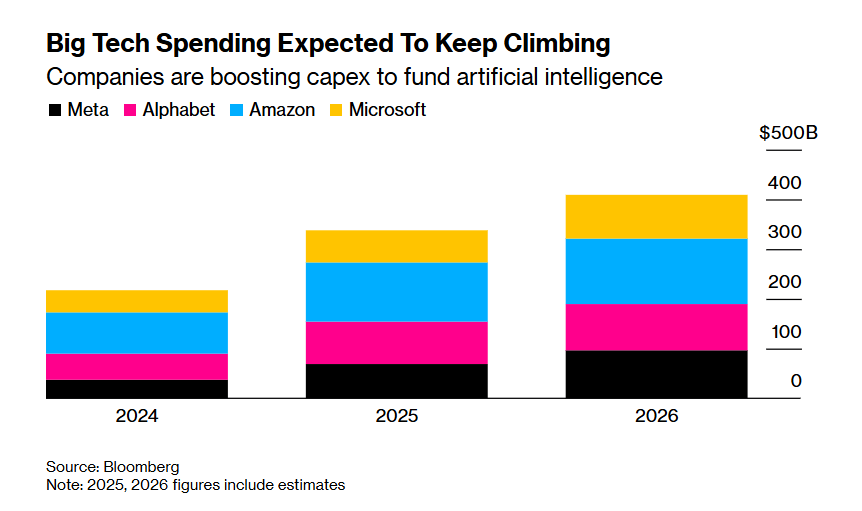
As the chart below shows, CAPEX spending by the big tech companies has been on a steady rise since 2024.
CAPEX Spending by Big Tech Companies
Source: Bloomberg
Yet, these funds continue to pour in even while many AI companies are not yet profitable. This is leading to an overvaluation of AI companies reminiscent of the dot-com bubble.
Also, the practical impact of AI on the bottom line of companies adopting them have been somewhat exaggerated. Only about 39% of organisations using AI attribute any level of EBIT impact to AI, according to a survey by McKinsey and Co., and most of them attribute less than 5% of their EBIT to AI use.
Does this then mean that euphoria has set in with AI?
On the other hand, analysts have pointed to the differences between what’s happening with AI and what happened during the dot-com bubble. For one thing, AI investment is driven by big-tech companies with sound fundamentals rather than fresh IPOs.
Also, the technology sector currently has a lower valuation premium than in the late 1990s, and the current macroeconomic policy space is more expansionary than it was then.
Furthermore, AI has real-world value, and it is capable of transforming different industries. It is also backed by cash-heavy companies that are building physical infrastructure that will aid the massive application and adoption of AI.
Some will look at all of these factors and ask if those parroting the AI bubble line are not themselves being subject to fear. So, is it fear or greed that is dominant in the AI space?
Geopolitical tensions
The disruption of oil supply at the Strait of Hormuz following the war between the US/Israel and Iran has led to global anxiety and fear.
Oil prices already crossed $100 on March 9, touching a high of almost $120, according to CNN. This has resulted in a sell-off in stock markets even as investors move into safe-haven assets like gold, US Treasuries, and the Japanese Yen.
On the other hand, energy and defence stocks are rallying in an excitement that may soon turn to euphoria.
Crypto market crash
The crypto market is currently dominated by fear, as panic selling and liquidity crunch dominate.
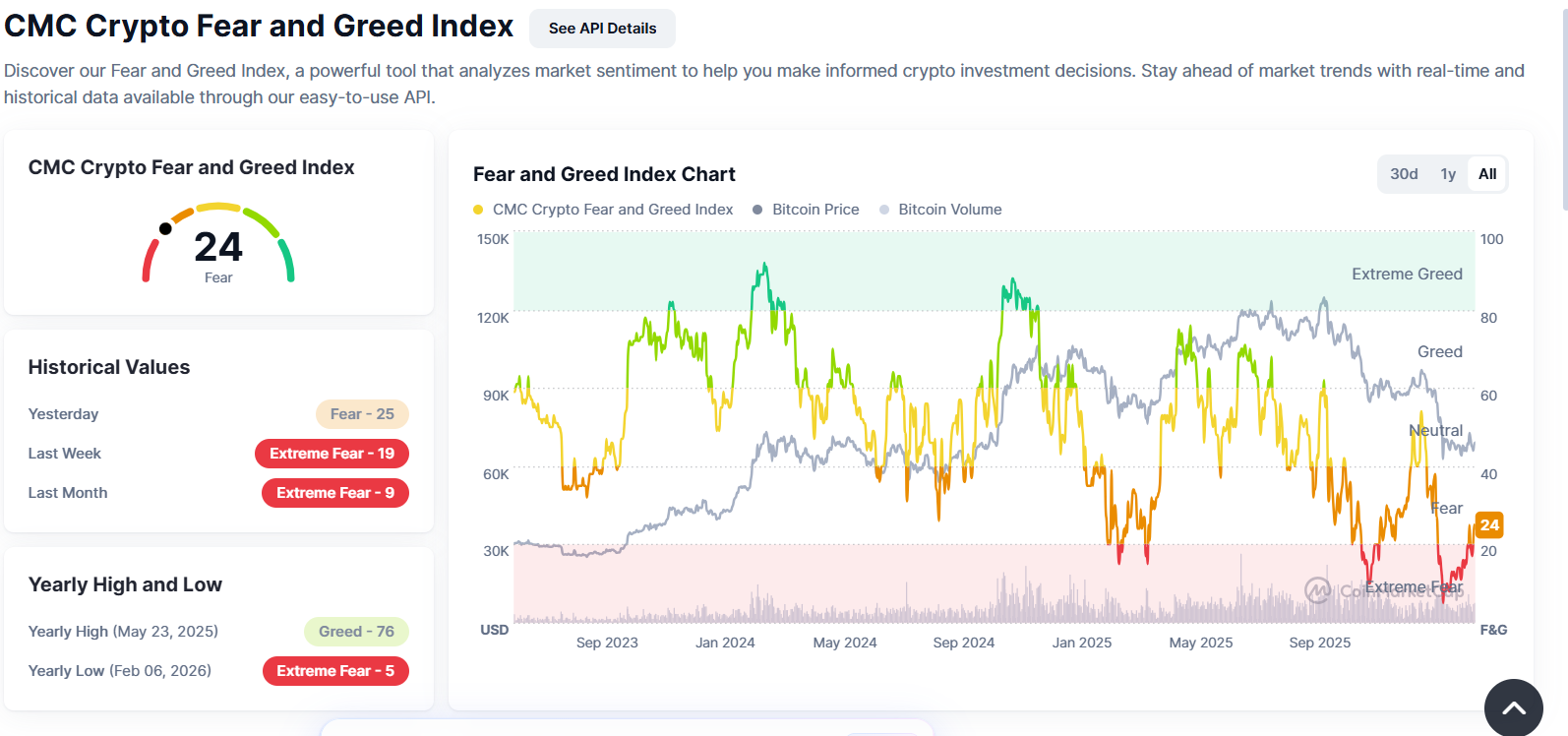
As seen below, the Crypto Fear and Greed Index is currently at 24, which is fear territory.
Crypto Fear and Greed Index
Source: CoinMarketCap
Interestingly, in May 2025, the crypto market was benefiting from euphoria as it crossed the $100,000 mark many times. Analysts talked about its bright future, especially as traditional financial institutions become more amenable to it (and other crypto assets).
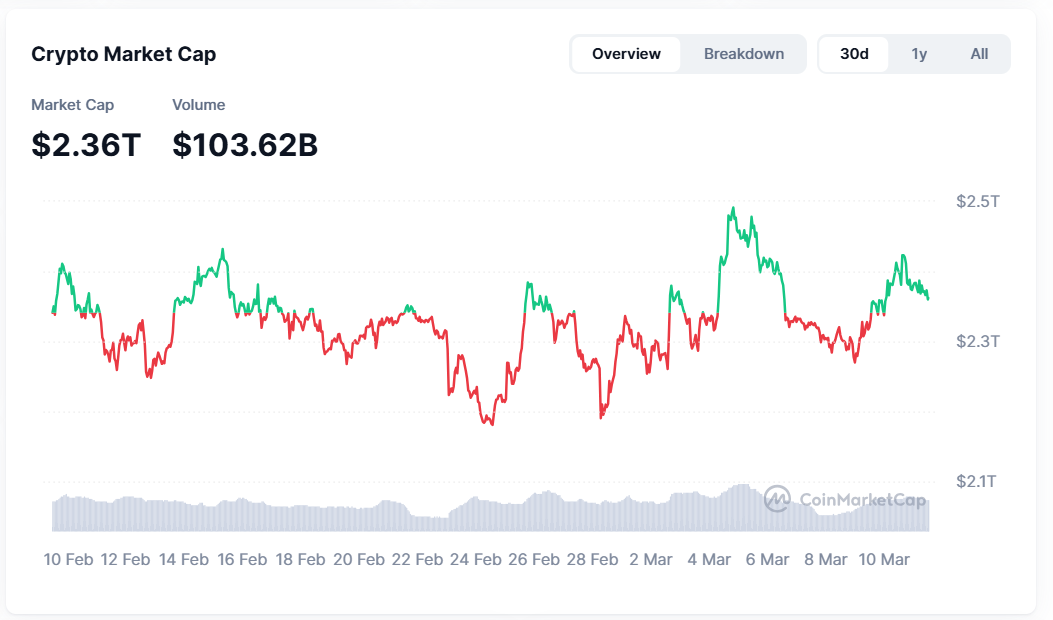
After peaking at $124,752 on October 7, 2025, bitcoin has fallen by 45.17% to close at $68,402 on March 10, 2026.
During the same period, the market cap of the entire cryptocurrency market, as seen below, dropped by 44.86%.
Cryptocurrency market cap
Source: CoinMarketCap
The US and foreign equity markets
One of the global restructuring trends taking place at the moment is de-dollarisation, as seen in the downtrend of foreign ownership of US Treasuries and diversification into international debt markets.
Also, geopolitical tensions, anticipation of lower rates, fiscal policy uncertainty, diversification into gold, the yen and the Swiss franc, and concerns about US trade and fiscal deficits have all contributed to a decline in the US dollar.
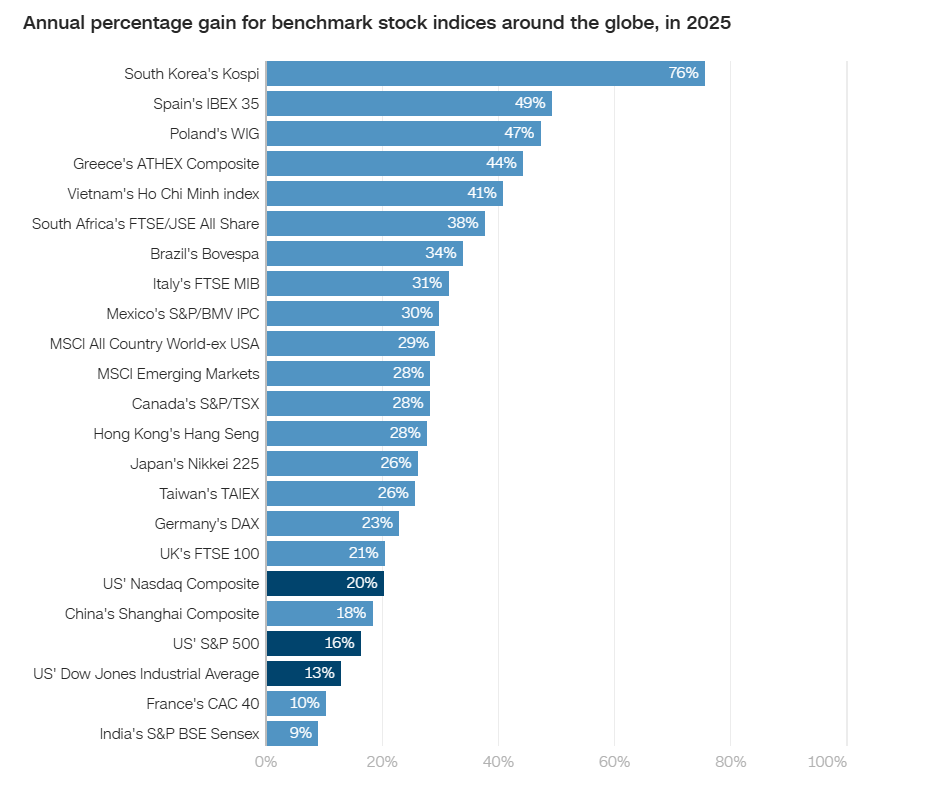
At the same time, international equity markets are prospering, with many of them in Europe and Asia outperforming the S&P 500 Index in 2025, as seen below.
Performance of different equity benchmark indices in 2025
Source: CNN
Some will argue that the trend towards international diversification is justifiable because of overconcentration of US indices in the technology sector and high valuations in the US market.
However, there is always the temptation that this trend will develop into fear and panic on the one hand (that makes people doubt the US) and greed and euphoria on the other hand (that makes people invest blindly in international markets).
3. Beyond fear and greed: Embracing disciplined investing in the current market
Warren Buffett popularised a contrarian investing strategy where investors identify current market sentiment and then act against it. This means buying during market fear when everyone is selling (prices are low) and selling during market greed when everyone is buying (prices are high).
However, this strategy has often been misunderstood and interpreted in a simplistic way. For many people, it is about checking the reading of market sentiment indicators like the Put/Call ratio and Volatility Index (VIX) for stocks and the CoinMarketCap Fear and Greed Index for crypto and then acting accordingly.
In reality, disciplined investing, as opposed to emotional investing, is about investing in line with what the fundamentals are saying rather than the noise of market sentiment.
Thus, Warren Buffett will only buy when others are fearful if the asset in view is a quality one and it's currently undervalued. Similarly, he will sell only when the asset becomes overvalued.
In other words, it’s not about being contrarian just for the sake of it. The key is identifying when the market is mispricing an asset or asset class and taking advantage of the situation.
“Institutional investors should stay disciplined: accumulate quality assets where sentiment has pushed valuations down,” said Deepak Shukla, the CEO of Pearl Lemon Finance, a business financing company. “For example, increasing exposure to temporarily out-of-favour sectors or undervalued growth companies while trimming overheated positions. The advantage institutions have is patience, deploying capital where fear creates pricing inefficiencies.”
Let’s see how this fundamentals vs market sentiment approach to investing works out with the four trends we have identified above.
Disciplined investing in AI
With AI, institutional investors need to stay between those motivated by fear on the one hand and by greed on the other hand.
“Fear and greed are two emotions that will keep investors from big gains,” according to Josh Perez, the managing director of Aurica Inc., a precious metals company. “When immediate shifts in the market happen, even institutional investors can get caught up in panic or overconfidence, often forgetting that their decisions don’t just impact their current status but also have long-term effects.”
In other words, both extremes can be costly and should be avoided.
Yes, many of these AI startups and companies are overvalued and can’t justify the funding they keep receiving. However, the right approach is not to ignore AI entirely but to focus on companies with strong fundamentals (real revenue, scalable business model, product-market fit, profitability).
Even if euphoria sets in and the AI bubble bursts, it is a given that some solid companies will still remain to build a stable ecosystem on the grave of the overhyped ones. The goal of smart institutional investors is to identify these solid companies and invest in them.
Secondly, diversification is key. Though AI startups hold the highest return potential, institutional investors should balance investment in them with stakes in stable hyperscalers and mature AI companies that will provide lower but consistent returns.
Disciplined investing in view of geopolitical tensions
After crossing the $100 mark on March 9, Brent crude oil is back at $90.
No one can be certain how short or prolonged this war will be. More importantly, we don’t know if it will later extend to oil infrastructure in the Gulf region.
If it’s short, oil prices may be back to pre-war levels and the equity market sell-offs may be quickly moderated.
A more extended war could see oil prices stay high for a longer period. This could also lead to rising demand for safe-haven assets, energy stocks, and defence stocks. On the other hand, airline and growth stocks could suffer significantly.
If the war extends to oil infrastructure in the Gulf, a global stagnation may result.
Nevertheless, institutional investors should avoid both fear and greed in light of the uncertainty of the situation.
On the one hand, the sell-offs in equity markets should be an opportunity to buy quality stocks at a discount rather than staying out of the market.
“Concerns about escalation are valid,” according to J.P. Morgan Private Bank. “Yet, through countless crises, wars, pandemics, and recessions, investors who have stayed the course have recouped losses and benefited from growth, innovation, and progress.”
If medium-term uncertainty remains a concern, then institutional investors should consider whether increased allocation to safe-haven assets is necessary.
“While we do not view a worst-case, escalatory scenario as our base case, selectively enhancing portfolio resilience—through assets such as gold, alternatives like hedge funds, volatility-aware strategies like structured notes, or investing alongside strategically important sectors—can help manage near-term uncertainty,” noted J.P. Morgan Private Bank.
On the other hand, institutional investors should be cautious of overexposure to crude oil or energy stocks based solely on current market sentiment.
Exposure to these assets should be considered only if long-term fundamentals in the industry justify it and they align with the institution's investment plans. As we all know, this is a very volatile market where wealth can be wiped out in an instant.
Disciplined investing in crypto
The current crypto crash is an opportunity to snatch up fundamentally sound crypto assets.
Institutional investors who have a long-term bullish view on any crypto asset should not ignore the crypto market due to current fears.
Let’s consider Bitcoin, for example.
Is Bitcoin a good investment? Many will argue that it can serve as a store of value, a potential inflation hedge, a diversification tool, and a risk-adjusted return amplifier. They will also point to its adoption by traditional financial institutions, including the growth of bitcoin ETFs.
If you are convinced about these arguments and believe in bitcoin’s long-term value, then you should see current market panic selling as an opportunity to increase your rate of return.
Disciplined investing in and out of the US
Though foreign ownership of US Treasuries is on a decline, the US dollar continues to maintain its dominance as the currency of choice for global transactions.
Also, though the concerns about the macroeconomic situation in the US are justified, one cannot deny that it is still the strongest economy in the world.
Warren Buffett advised that one should never bet against America. Therefore, any attempt at international diversification should not involve a long-term bearish outlook on America or a radical divestment away from its assets.
Institutional investors should be realistic about America while refusing to be dragged into an unjustified fear that makes them miss out on the glories of American capitalism.
“One should be careful about betting against the US, as its innovative economy and strong institutions have historically delivered solid returns for investors, supporting the currency,” according to Investec, a financial services group. “The recent outperformance of US firms invested in the growth of artificial intelligence are examples of the US’s leadership in major technology trends.”
On the other hand, investing in emerging economies should be treated with caution.
Past experiences (the Asian Financial Crisis, the Russian Debt Crisis, and the Eurozone Debt Crisis, among others) have shown that internal and external (via the contagion effect) macroeconomic changes can turn the darlings of international investors into outcasts as everyone looks to cut short their losses.
Though global diversification is one of the best investment strategies for 2026, institutional investors should not allow the allure of high equity returns to make them forget the importance of due diligence and sound risk management.
One way for institutional investors to avoid suffering from the fear-and-greed cycle is to bounce their ideas against other financial market experts.
Sometimes, the wisdom of other experts can help asset managers make more informed decisions instead of being motivated simply by animal spirits.
At cio investment club, we provide you with a network of asset managers, asset owners, and other investment experts with whom you can exchange ideas and share investment opportunities.
We also organise exclusive roundtables and investment breakfasts where you can network with like-minded professionals from across the globe.
Do you want to be part of an investment community that will help you make better-informed portfolio decisions? Register today to be a part of the cio investment club.
Takeaways
- Investor psychology often fuels bubbles, crashes, and widespread mispricing in financial markets.
- Many investors buy near market peaks during euphoria and sell near bottoms during panic, locking in losses. These losses can also trigger wider negative economic impacts.
- AI enthusiasm, geopolitical tensions, crypto volatility, and global market shifts are creating powerful fear-and-greed dynamics.
- Successful institutional investors must focus on fundamentals, diversification, and long-term value rather than overreacting to short-term sentiment.