


No matter how popular passive management becomes, for institutional investors, the flexibility of active management will always be a game-changer.
In the search for alpha, only institutional investors who can quickly identify and adapt to new economic trends will thrive.
At the moment, trends such as artificial intelligence, global supply chain transformation, dedollarization, geopolitical tensions, and sectoral shifts, among others, are underpinning a global restructuring.
Asset managers who understand these trends and adapt their portfolios to the new reality will be in a better position to generate alpha for asset owners.
In this article, we consider the nature of the current global restructuring and the implications it has for both asset owners and managers. We’ll cover:
- The global restructuring: Six trends transforming the global economy
- Staying the course: How institutional investors can respond to the global restructuring
Do you want to keep a tab on the latest developments in the global economy and understand how they impact your portfolio? Subscribe now to cio investment club’s newsletter for regular updates.
1. The global restructuring: Six trends transforming the global economy
1. Artificial intelligence and global productivity
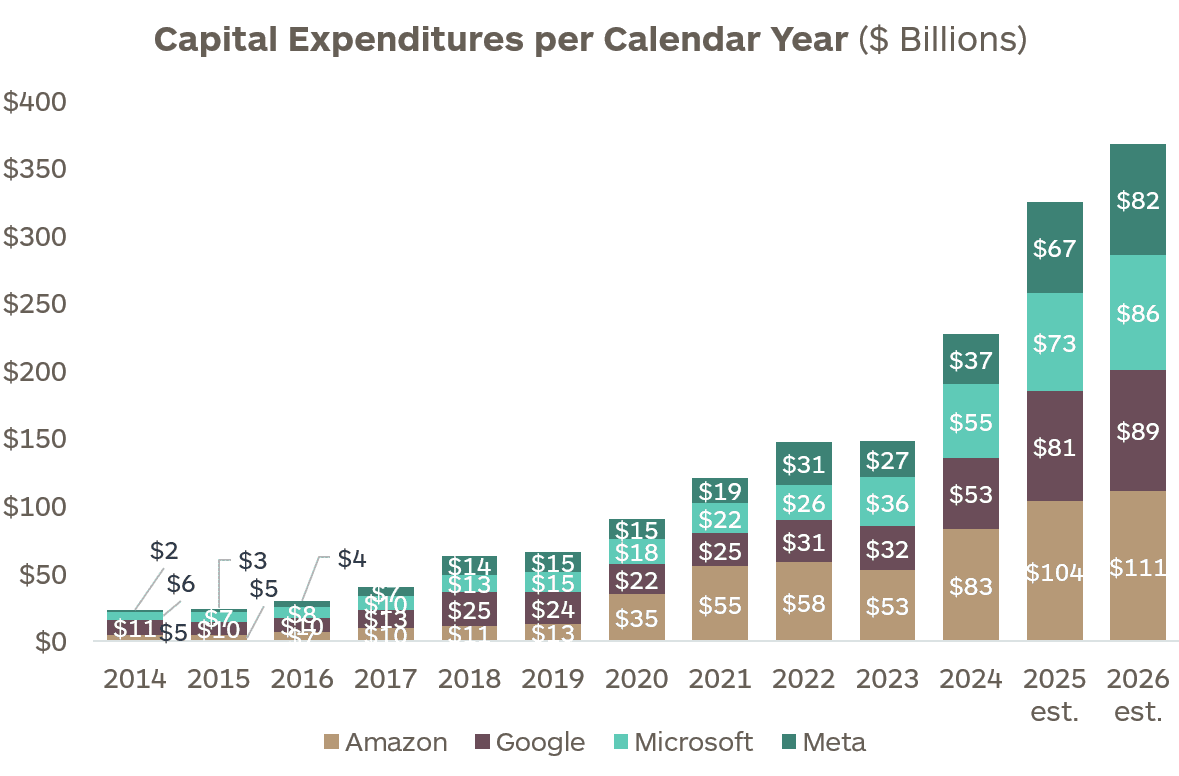
Since 2025, big tech companies have committed to significant capital expenditure (CAPEX) in artificial intelligence.
In the United States, the current CAPEX cycle is higher than that of the telecom bubble of the 1990s, according to Barclays, a global financial firm.
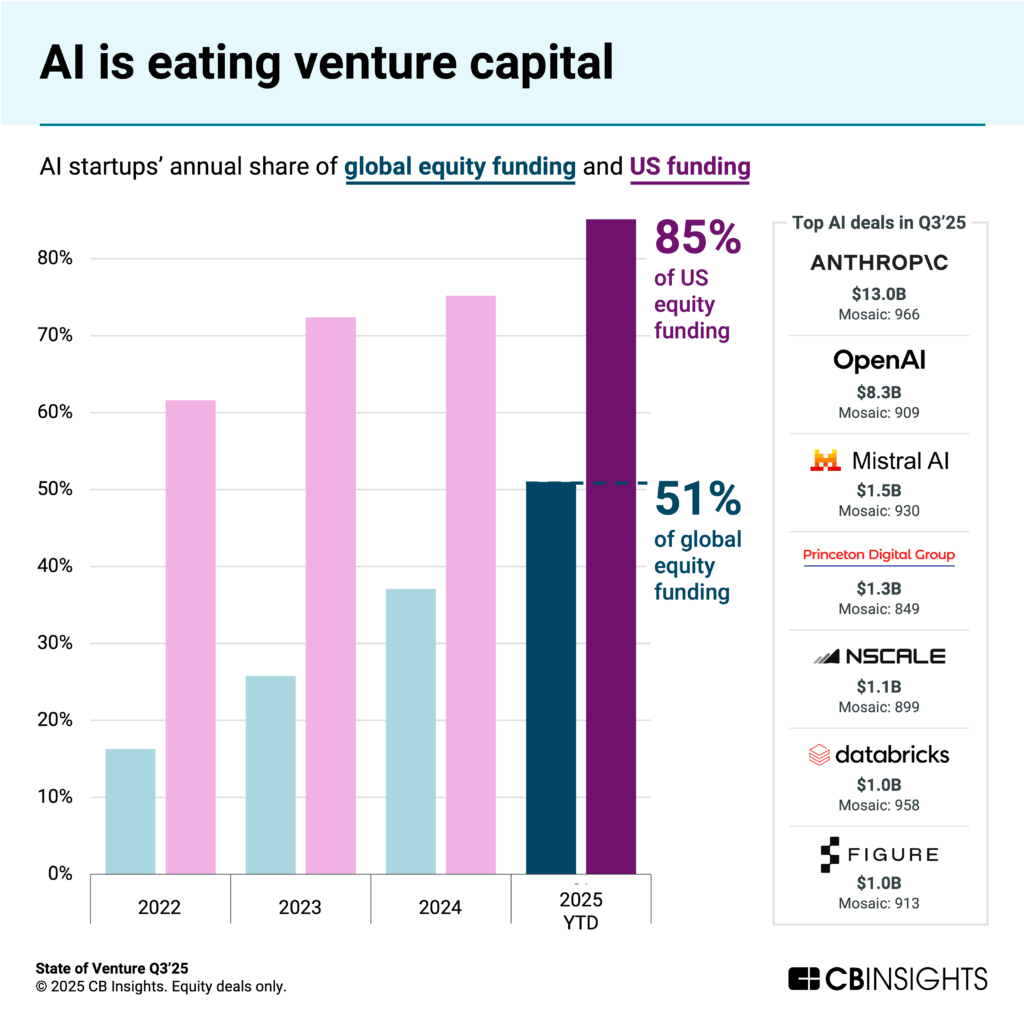
Similarly, AI captured 51% of global venture capital funding as of Q3, 2025, according to CB Insights, a business analytics and market intelligence platform.
Source: CB Insights
The investment in AI was so explosive that many analysts started expressing concerns about an AI bubble and the possibility of a burst, reminiscent of the dot-com bubble.
The United States economy continues to face challenges arising from trade uncertainty, a sluggish job market, and a stagnant housing market. However, all of these have been moderated by the increase in economic activity and wealth (arising from a thriving stock market) that has followed from the AI boom, according to Barclays.
A similar pattern holds for the global economy. Though the global economy’s resilience is under strain, the adoption of AI could drive growth and ease some of the constraints it faces, according to EY, a global consulting company.
“Faster-than-expected diffusion of AI technologies represents an important upside risk — one that could unlock productivity gains, ease supply side constraints, and reshape growth potential across sectors and regions,” they noted.
More importantly, Barclays highlights that AI is not a fad but a transformative technology that will have considerable impacts on the global economy. They back this up by pointing to AI adoption across service sectors and the record-breaking profits announced by some of the largest technology firms.
Below are the transformative impacts that AI is expected to have on the global economy, according to Cerity Partners, a wealth management firm in the US:
- Economic growth: An increase in productivity will lead to a non-inflationary increase in economic growth.
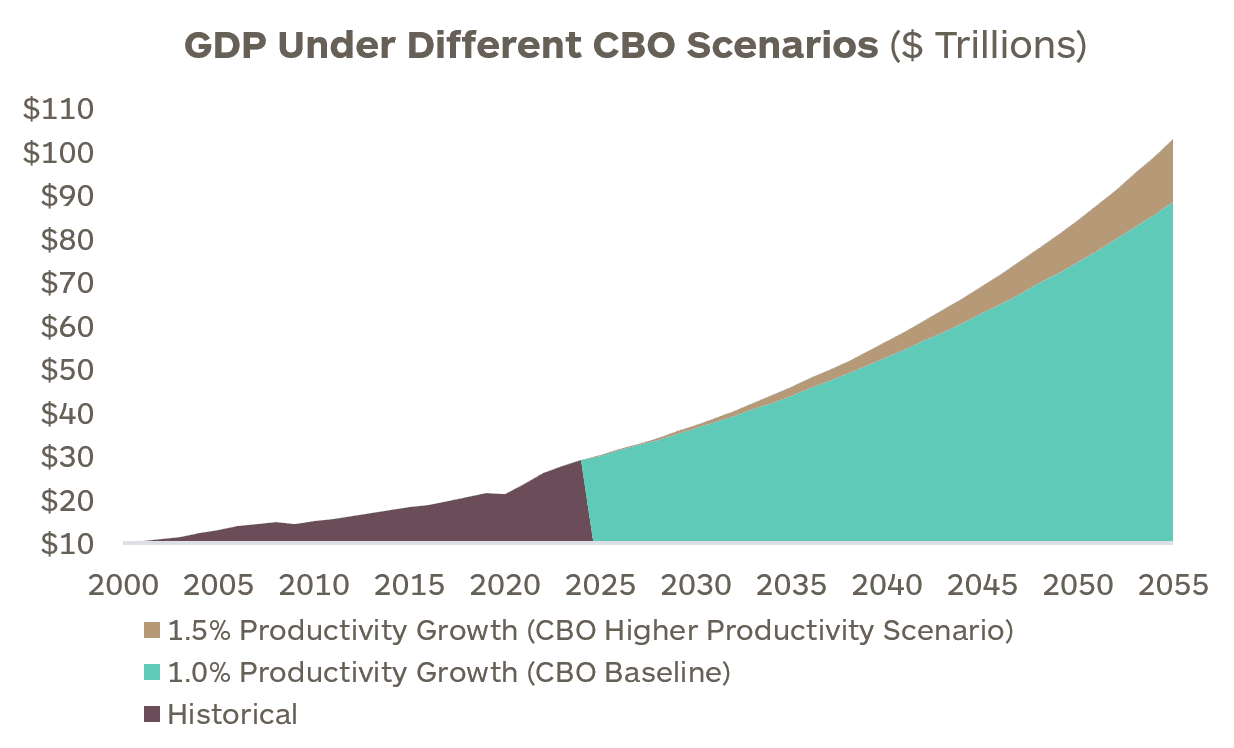
As the chart below shows, a 0.5% increase in productivity can increase global GDP by up to $20 trillion, according to the Congressional Budget Office:
Source: Cerity Partners
- Change in the workforce: Many jobs involving repetitive tasks will be lost, while more jobs requiring problem-solving skills and creativity will be created. This might lead to the widening of the income gap.
- Some sectors will benefit while some will suffer: Technology and communication services, semiconductor, healthcare, data warehouses, power generation, and insurance underwriting are some of the sectors that will thrive.
On the other hand, some jobs will be lost in financial advisory and weather forecasting, for example.
- Higher energy costs: The demand for electricity by data centres will be so massive that it will likely drive up electricity prices, resulting in a global concern about energy costs.
- Increase in CAPEX: As Barclays emphasised, big tech companies are increasing CAPEX spending at unprecedented rates. Cerity Partners expects this to continue, as seen below:
Source: Cerity Partners
2. Concerns about de-dollarisation and the safe-haven status of US Treasuries
In recent years, there have been talks about whether the place of the dollar in the global economy is under threat. These discussions were especially heightened due to the outflow from US securities that occurred after Trump announced new tariff policies in H1, 2025.
At the beginning of H2, 2025, J.P. Morgan, a global financial institution, took a lay of the land, showing in what ways the dollar was losing its dominance.
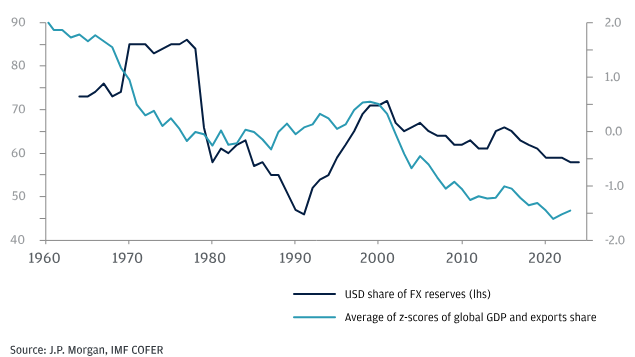
They found that de-dollarisation was evident in three ways. First, the share of the dollar in central banks’ FX reserves was at a two-decade low, as seen below:
Source: J.P. Morgan
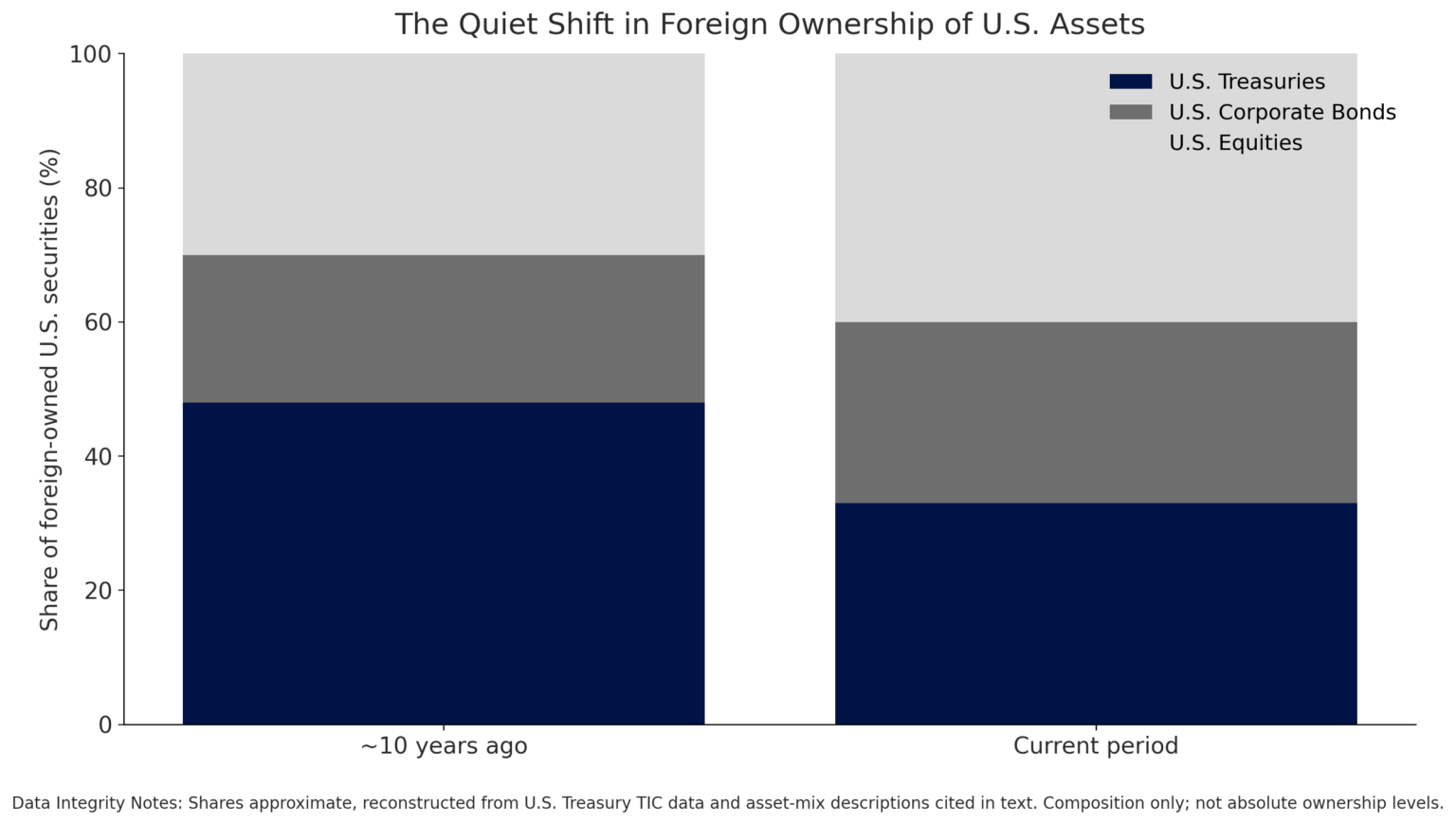
Second, the share of foreign ownership in the U.S. Treasury market has been falling over the past 15 years. We can see an example of this in the chart below:
Source: Preserve Gold
Third, non-dollar-denominated contracts were becoming more popular in the energy market.
But this was not the whole story.
“Nonetheless, the transactional dominance of the dollar is still evident in FX volumes, trade invoicing, cross-border liabilities denomination, and foreign currency debt issuance,” they noted.
Yet, the BRICS (led by Russia) and China continue to advocate de-dollarisation, even as solutions like Central Bank Digital Currencies (CBDCs) aim to make that path easier.
In the end, it seems that the dollar’s position as the global reserve currency remains unchallenged, at least from a transactional point of view.
However, when it comes to safe-haven investment in the US Treasury securities, investors are having a rethink and opening up to other economies and alternatives like gold, according to Preserve Gold, a precious metals dealer.
“As policy coherence frays and fiscal discipline becomes harder to rely on, demand for U.S. assets grows more conditional,” they noted. “The dollar’s privilege, once treated as an entitlement, increasingly looks like a performance review. The United States can still borrow in its own currency and supply the world with safe assets, but it does so under closer scrutiny. Trust hasn’t disappeared, but it’s no longer automatic.”
3. Supply side volatility and the search for resilience
A global restructuring has also been necessitated by supply-side volatility that has been putting pressure on the global supply chain.
In other words, while global demand has been persistent, supply has been volatile, leading to cost volatility, input uncertainty, and structural growth hurdles
Five factors have been responsible for this volatility, according to EY:
- Policy-driven trade realignments: Trump’s tariff policies led to an increase in the average tariff rate of the US. It went from 2.4% at the end of 2024 to 16.8% at the end of November 2025. Also, trade between the US and China fell by 35% between 2024 and 2025.
Furthermore, many economies across the globe are adopting trade protectionism to varying degrees to protect domestic industries and/or in response to populist demands.
- Uneven AI acceleration: While acknowledging the positive impacts of AI that we have mentioned above, EY also recognises that it can contribute to supply chain volatility.
“More broadly, there are questions about sustainability, particularly around return on investment, balance-sheet concentration, and rapidly increasing energy demand,” they noted. “Together, these factors are now central to the debate over whether the current AI cycle carries elements of speculative overextension.”
Though output per worker can increase, a slowdown in job growth will also result in certain industries and sectors. Also, the fear of missing out (FOMO) will lead to a misallocation of capital to AI and a deepening of operational vulnerabilities.
- Shifting rate and currency dynamics: The disconnect between short-term and long-term interest rates can discourage long-term investment (due to higher borrowing costs) even when central banks reduce policy rates.
They also note the current de-dollarisation efforts and how it reinforces the sensitivity of investors and businesses to certain concerns about the US, including fiscal sustainability, central bank independence, and the potential weaponisation of the dollar in geopolitical disputes.
- Widening fiscal pressures: High debt levels and elevated interest rates in many advanced economies could lead to fiscal policy constraint which means lower long-term investment, less welfare support, and high borrowing costs for businesses, among others.
The rise in ageing populations is worsening this situation, as governments have to take on more long-term obligations even as their capacity to finance such obligations is dwindling.
Furthermore, increased defence spending, necessitated by geopolitical concerns, will further constrain the scope for welfare spending or long-term investment.
- Demographic constraints: Lower fertility rates and a rising ageing population are reducing labour age participation rates in many advanced economies. At the same time, there has been a push towards more restrictive immigration policies.
Slower labour force growth will lead to lower output except in industries where higher productivity can compensate for it. Also, businesses in industries where productivity growth lags will face higher labour costs in the interim.
On the other hand, countries with stronger demographic profiles will play larger roles in the global supply chain.
4. Cross-border restructuring and M&As on the rise
Many companies have responded to supply chain disruptions caused by changing trade policies with cross-border restructurings.
This is especially popular with companies reassessing their China footprint due to trade policy issues and other geopolitical tensions.
Instead of fully exiting China, companies are embracing cross-border restructuring as a way to take advantage of China’s strengths, mitigate against the risk China poses, and explore the advantages of other jurisdictions.
“Companies can reduce geopolitical exposure while retaining China’s strengths by shifting certain parts of production, typically low‑value or labour‑intensive activities, to ASEAN or South Asia, while keeping R&D, quality control or domestic sales operations in China,” according to FOCUS, a blog operated by the China-Britain Business Council (CBBC).
Similarly, there has been an increase in cross-border mergers and acquisitions (M&As) as a way to deal with cross-border insolvency.
Insolvency proceedings are often complex due to the difficulty of interpreting insolvency laws across jurisdictions (especially regarding the treatment of lenders) and coordinating liquidation proceedings among different insolvency practitioners and across different courts.
When a multinational company faces insolvency across jurisdictions, a cross-border M&A can be a solution, especially if the company plays a key role in the supply chain.
If there’s distressed debt, a debt restructuring process may take place during the M&A process. Also, when the M&A has been completed, a corporate restructuring process may follow to ensure that there is a strategic fit that will contribute to supply chain resilience.
5. Geographical portfolio diversification
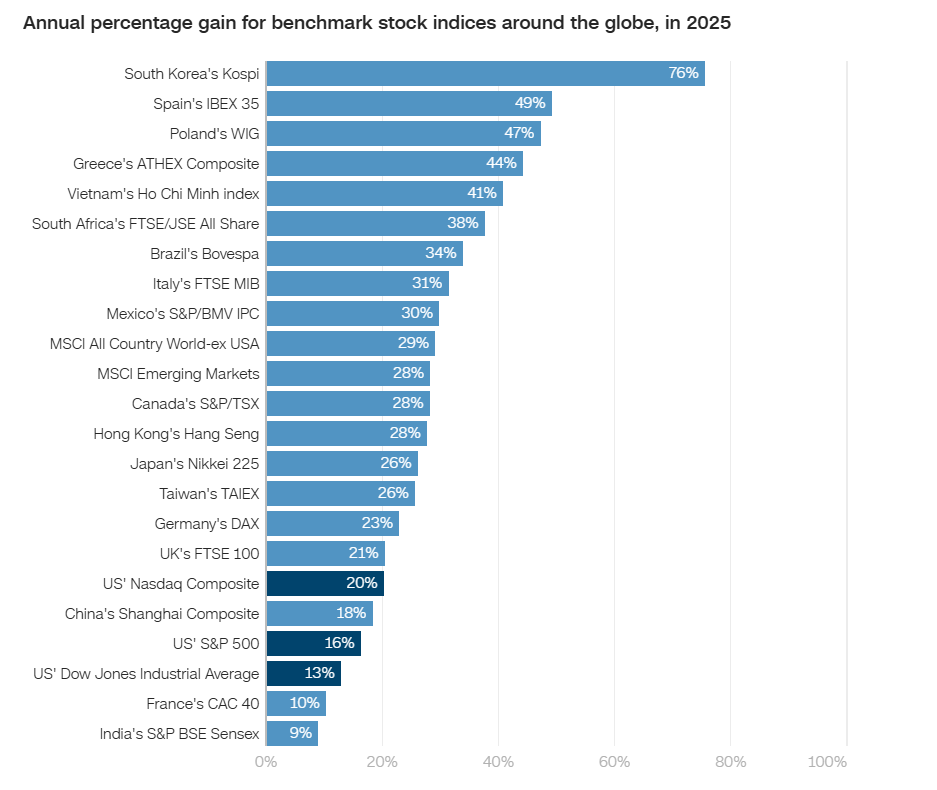
At the same time that policy uncertainty was leading to concerns about the US economy, other economies outside the US were boasting stronger equity performance.
“After a couple years of lacklustre fundamentals, foreign equities put together a strong year of earnings growth,” according to Michael Reynolds, vice president of investment strategy at Glenmede, a wealth management firm, in an interview with CNN. “This was highlighted by fiscal stimulus in Europe and AI-related growth in Asia.”
In Asia, growth was spurred by investment in AI in South Korea, Japan, China, and Taiwan.
Similarly, European stocks benefited from an increase in defence spending in Germany, while Poland, Spain, and Greece profited from improved fundamentals.
As seen below, many foreign indices outperformed the S&P 500 Index in 2025:
Source: CNN
Though analysts expect the US dollar to make a recovery that will spur the US equity market going forward, current realities suggest that this global restructuring will continue.
“Overweighting the US has served global investors well the past 15 years,” according to Lisa Shalett, chief investment officer at Morgan Stanley Wealth Management, in a note to CNN. “That said, we believe shifting geopolitical, monetary and fiscal policy regimes amid technological upheaval and the constraints of developed world debt are creating a need for diversification beyond US stocks and bonds for long-term investors.”
6. The link between geopolitics, trade, and investment flows
We noted earlier that trade between the US and China declined by 35% between 2024 and 2025.
The economic issues between the US and China reflect broader political dynamics that continue to impact the global economy.
As the US restricts China’s access to its technological developments, China is accelerating domestic innovation, building alternative supply chains, and also developing products that can rival the US’s.
Also, we noted above that China (together with the BRICS) are challenging dollar dominance and leading the charge towards more de-dollarisation.
As a result, many companies are diversifying their supply chains away from China due to such geopolitical risks, exploring alternatives in Europe, India, and Southeast Asia.
“As FDI into China declines, countries straddling geopolitical fault lines are attracting investment and positioning themselves as links between the US, China, and other major economies,” according to Capital Group, an investment management firm. “Meanwhile, US outbound FDI is declining just as China ramps up its own overseas investments. The result appears to be that regions outside the US are strengthening economic and political ties with each other, suggesting US protectionist policies may be contributing to increased cooperation among other major economies.”
As an instance of this, both US tariffs and the war in Ukraine are creating a more united Europe, as the region seeks greater economic and strategic autonomy.
In other words, the link between geopolitics and geoeconomy will continue to result in global restructuring, especially in a world where nationalistic tendencies are making a comeback.
“The smartest institutions aren't just checking ESG boxes,” according to Josh Katz, a Certified Public Accountant at Universal Tax Professionals. “They're building real frameworks to evaluate investments based on geopolitical stability, where regulations are headed, and tax efficiency in this new world. The winners will be the ones who treat geopolitical strategy as a core skill, not just another risk to manage.”
2. Staying the course: How institutional investors can respond to the global restructuring
Again, asset owners and managers who can adapt to these trends by making smart portfolio allocation choices can benefit from the global restructuring that is taking place.
“AI productivity gains, countries moving away from the dollar, and reshuffled supply chains aren't separate issues,” according to Katz. “They are all connected, and they're changing the entire risk-return picture for major asset classes.”
What will this adaptation look like?
There are five points to consider:
Smart investment in AI and industries benefiting from it
AI is the new global play. We have seen that the productivity gains expected from it are meant to sustain global economic growth amid significant challenges to that growth.
However, as EY noted, FOMO will lead to misallocation of capital in the AI space. Many companies will spring up with high valuations that are not matched by strong fundamentals (especially revenue and profit). When it seems there is an endless money flow, high market valuations cannot be a reflection of intrinsic value.
“Investors are miscalculating the total cost of ownership for AI integration within their portfolios,” according to Jon Morgan, Co-Founder of Venture Smarter, a company helping new businesses launch. “My team consistently sees startups that project a 15% efficiency gain but end up with implementation costs running 30% over budget within 18 months. These funds are chasing AI-driven valuations without stress-testing the underlying data infrastructure or the legal exposure from model biases. This oversight creates a valuation bubble where companies are overvalued by at least 20% based on tech hype rather than operational reality.”
Thus, institutional investors should look beyond headlines when selecting AI companies to invest in, whether through private equity or public equity.
Also, institutional investors should consider thematic investing in AI to capture the wide range of companies in various industries and sectors that are benefiting from the AI revolution. This may also help to hedge against the risk of investing in individual AI companies.
Reducing concentration in the US
AI is also spurring equity markets outside the US. We have seen how equity markets in the Asia Pacific enjoyed a prosperous 2025, buoyed by the AI revolution.
Similarly, high valuations in the US and the overconcentration of the S&P 500 Index in technology companies make diversification outside of the US a reasonable option.
Also, we have seen that fiscal and monetary policy uncertainty in the US has led to a financial, if not transactional, de-dollarisation.
All of these show that the era of overconcentration in the US may be over for good. Institutional investors who are still living in this area may reshuffle their portfolios to reflect new realities.
Keeping an eye on inflation
Inflation in most advanced economies is above the 2% target. Yet, it is not currently high enough to be problematic.
However, we have seen that the electricity demand by AI data centres could increase energy costs. Also, geographical changes could increase labour costs, especially in industries where productivity gains are slow. Finally, trade protectionism could lead to higher prices across the globe.
Thus, institutional investors should make investment decisions with the possibility of a higher inflationary era in mind. This could mean increasing allocations to commodities like gold, silver, and crude oil or to a commodities ETF.
Focusing on fundamentals
While there has been a resurgence of interest in foreign equities and bonds, institutional investors should pay attention to the fundamentals behind an economy before investing in it.
Also, as said above, AI investment should be based on fundamentals rather than mere hype.
Embracing comprehensive risk management
While many investors are capable of dealing with endogenous risk, the nature of the global restructuring requires that investors have the know-how to manage exogenous risks coming from policy shocks, geopolitics, currency realignments, supply shocks, demographics changes.
In other words, only comprehensive risk management that pays attention to both endogenous and exogenous risk factors can lead to sound investment management.
For example, international diversification or cross-border portfolios present fresh challenges that institutional investors must carefully navigate.
“From where I sit, working with cross-border portfolios, the bigger issue that nobody's talking enough about is multi-polar compliance and taxation,” said Katz. “As capital flows shift to new trade routes and currency systems, investors are dealing with a messy tangle of new regulations across different regions.”
He goes on to give an example of investing in a Southeast Asian data centre with diversified energy sources. “That's not just a tech play anymore,” he said. “You're taking a position on regional supply chain security, and you're dealing with evolving data sovereignty laws and potentially brand new tax treaties.”
Paying attention to both exogenous and endogenous risk factors will be crucial to investing in this new global economy.
The foundation of such comprehensive risk management is awareness of happenings in the global economy. Only asset managers who can keep a tab on the latest economic developments and their impacts can make sound decisions.
At the cio investment club, we provide you with a network of asset owners and managers with whom you can share information, exchange ideas, and discuss happenings in the global economy that will impact investment decisions.
We also organise exclusive roundtables and investment breakfasts where you can meet other players in the financial markets and engage in conversations that can lead to partnerships and collaborations down the line.
Are you ready to be a part of an investment club that will help you improve your risk management processes? Register today to join the cio investment club.
Takeaways
- In a fragmented, fast-shifting global economy, institutional investors need the flexibility that comes with active management.
- AI will drive productivity and growth, but FOMO risks misallocation. Fundamentals, not headlines, must guide allocation decisions.
- De-dollarisation pressures, US concentration risk, and stronger fundamentals abroad make geographic diversification a structural necessity.
- Geopolitics, demographic changes, policy shocks, and supply volatility require scenario-based, forward-looking, and comprehensive risk frameworks.
This document is produced by Instaconnect Limited, trading as cio investment club, a company registered in England & Wales with registration number 15262951.
Instaconnect Limited is neither authorised nor regulated by the Financial Conduct Authority in the United Kingdom nor the Securities and Exchange Commission in the United States of America.
This document is a marketing documentation and is not intended to constitute an invitation or an inducement to engage in any investment activity. It is not intended to constitute investment advice and should not be relied upon as such. It is not intended and none of Instaconnect Limited, its holding companies or any of its or their associates, or any of the participants in the documentation, shall have any liability whatsoever for (a) investment advice; (b) a recommendation to enter into any transaction or strategy; (c) advice that a transaction or strategy is suitable or appropriate; (d) the primary basis for any investment decision; (e) a representation, warranty, guarantee with respect to the legal, accounting, tax or other implications of any transaction or strategy; or (f) to cause Instaconnect Limited to be an advisor or fiduciary of any recipient of this report or other third party.
The content and graphical illustrations contained in this document are provided for information purposes and should not be relied upon to form any investment decisions or to predict future performance. Instaconnect Limited recommends that recipients seek appropriate professional advice before making any investment decision. Although the information expressed is provided in good faith, Instaconnect Limited does not represent, warrant or guarantee that such information is accurate, complete or appropriate for your purposes and none of them shall be responsible for or have any liability to you for losses or damages (whether consequential, incidental or otherwise) arising in any way for errors or omissions in, or the use of or reliance upon the information contained in this document.
To the greatest extent permitted by law, we exclude all conditions and warranties that might otherwise be implied by law with respect to the document, whether by operation of law, statute or otherwise, including as to their accuracy, completeness, or fitness for purpose.
Instaconnect Limited and its logo are proprietary trademarks of Instaconnect Limited and are registered in the United Kingdom. Unauthorised copying of this document is prohibited.
© Copyright Instaconnect Limited 2026