


For many people, high volatility remains the major impediment to using cryptocurrencies as a payment method or investment asset. The rapid rise and fall of these digital assets is just too much for them.
Stablecoins propose to solve that problem. These are digital assets that are backed by other assets, usually, but not exclusively, a fiat currency like the US dollar. Thus, the value of the stablecoin tracks that of the underlying asset. Since fiat currencies (especially reserve currencies like the dollar) are stable, stablecoins have a stability that typical crypto assets don’t.
Individuals and businesses have embraced stablecoins for low-cost, safe, and accessible cross-border payments, as well as for the purchase of other cryptoassets.
But how safe are stablecoins?
We have seen stablecoins lose their pegs to the US dollar. Regulatory uncertainties about them persist in some jurisdictions. Concerns about custodial and liquidity risk also remain. Given all of these, can they still be regarded as the safe solution to the volatility issues of cryptoassets?
We will answer this question by considering:
- How do stablecoins work in reality?
- How safe are stablecoins? 4 concerns about safety and stability
- Why stablecoins remain relevant in finance
- How should institutional investors approach stablecoins?
Do you want to know more about stablecoins and how to navigate the larger cryptocurrency market? Subscribe today for the cio investment club’s newsletter for regular updates about various alternative assets.
1. How do stablecoins work in reality?
To appreciate the safety and stability issues stablecoins face, it is crucial to get a good grasp of how they operate.
There are four processes crucial to the operation of stablecoins:
Issuance
This is the stage where a company decides to issue a stablecoin.
BitUSD was the first stablecoin in the crypto market. It was issued in 2014 by BitShares, a blockchain platform. Tether (USDT), which is now the most popular stablecoin, was issued by Tether Limited in 2014, months after BitUSD.
When issuing a stablecoin, its value must be pegged to a stable asset. (As we saw above, this is where it derives its stability.)
There are four types of stablecoins based on the asset backing them:
- Fiat-backed stablecoins: These are stablecoins whose value is pegged to a fiat currency, with the dollar being the most popular one. Tether (USDT), USD Coin (USDC), and Binance USD (BUSD) are backed by the US dollar.
For a fiat-backed stablecoin, the issuer holds a corresponding amount of the fiat currency in reserve. For example, for every USDT issued by Tether Limited, there must be $1 in reserve. Thus, if they issue USDT 5 billion, for example, then they must have $5 billion in reserve to back that volume of stablecoins.
- Crypto-backed stablecoins: These are stablecoins collateralised by other cryptocurrencies.
When a user deposits a specified amount of cryptocurrency (usually Bitcoin and Ethereum, but not limited to these), the issuer mints a corresponding number of stablecoins.
To automate the process and make it transparent, users deposit cryptos into a smart contract.
But if stablecoins were created to deal with the volatility of crypto assets, why use the same crypto assets as collateral? That’s a good question.
Crypto-backed stablecoins address this issue through overcollateralisation. Users must deposit crypto that is worth more than the value of the stablecoin they want.
To use the most popular crypto-backed stablecoin, DAI (issued by MakerDAO), as an example, a user who wants $100 worth of DAI may need to deposit $140 worth of BTC or ETH.
Also, if the value of the collateral drops significantly, the smart contract will trigger the liquidation of the stablecoin.
- Commodity-backed stablecoins: These are similar to fiat-backed stablecoins except that they are backed by commodities like gold instead of currency. Thus, for every stablecoin issued, there must be a corresponding commodity value that serves as collateral.
Gold and silver have proven themselves as stable commodities and safe-haven assets over centuries, so it makes sense to peg the value of stablecoins to them.
Moreover, since it is costly to increase their supply, they are less inflationary compared to fiat currencies.
Tether Gold (XAUT) and Paxos Gold (PAXG) are the two most liquid and popular commodity-backed stablecoins. Every Tether Gold issued, for example, is backed by one ounce of gold. At the time of writing, one Tether Gold is worth $3,542, which is approximately the spot price of an ounce of gold.
- Algorithmic stablecoins: These are stablecoins that seek to maintain stability without holding any collateral.
How can that be if collateralization is key to the stable value of stablecoins?
Well, they use smart contracts and algorithms to automatically adjust the supply of the stablecoin in response to fluctuations in market demand. This matching of supply to demand helps to achieve parity with a fiat currency like the US dollar without needing reserves.
Let’s make this clearer with an example. Ampleforth (AMPL) is one of the popular algorithmic-backed stablecoins.
If the price of AMPL rises above $1, the protocol will increase supply by minting new tokens. The rise in supply will bring down the price until it is back at the $1 peg. On the other hand, if the price is below $1, supply can be reduced (by burning tokens), leading to a price rise.
The rules for adjusting supply in response to price movements are coded in smart contracts. This helps to automate the entire process.
Distribution
Once minted, stablecoins are distributed to the public.
Users can buy them directly from the issuer or on a cryptocurrency exchange. Once purchased, they are stored in wallets. Since they have many use cases, stablecoins can also be stored on decentralised exchanges (DEXs).
Stablecoin transactions are recorded on a blockchain ledger. Since these ledgers are publicly available, ownership can be verified by anyone. This enhances transparency.
Usage
Once they are available in a wallet, stablecoins can be used for multiple purposes.
On centralised exchanges (CEXs), users can transfer them to other wallet holders, use them to make purchases, trade them for other crypto assets, among others. They can also use them to fund crypto cards that can be used for online and offline purchases.
On DEXs, they can be a gateway to access decentralised finance services like staking, yield farming, lending, and the purchase of a variety of tokens.
Redemption
Users can redeem fiat-issued stablecoins for fiat currency by selling them back to the issuers. The issuer will receive the stablecoins and send the underlying amount in fiat via ACH or wire transfer.
This will involve the payment of fees, opening an account with the issuer, and KYC documentation, among others.
An easier way is to sell them for fiat on centralised exchanges. While this is more stress-free, crypto-to-fiat conversion is not available for every country.
For crypto-backed stablecoins, the user will have to burn the stablecoin to unlock the collateral. Issuers of crypto-backed stablecoins often have a dedicated platform where users can easily do this.
As we have seen, algorithmic-based stablecoins don’t have collateral. Thus, there is nothing like redemption. Users can only buy and sell at the prevailing price.
Lastly, commodity-backed stablecoins can also be redeemed. If the user meets a certain minimum threshold, they can redeem for the commodity itself. Otherwise, they can redeem for a cash equivalent via wire transfer or a crypto-to-fiat conversion on centralised exchanges.
Now that we understand the processes involved, let’s consider questions of safety and stability.
2. How safe are stablecoins? 4 concerns about safety and stability
What statement about stablecoins is not true?
It is this: “Stablecoins are completely risk-free and can never lose their value.”
While stablecoins seek to solve the volatility issues associated with crypto assets and make them more mainstream as a payment method and investment asset, they come with certain risks:
Lost pegs: A history of instability
Do stablecoins change in value? Yes, they do.
Users don’t consider this a big problem as long as the changes are minor and occasional. For example, USDC is currently trading at $0.9998. No one will lose sleep over that minute tracking error.
However, there have been times when stablecoins became untethered from their collateral and lost their pegs, permanently or temporarily.
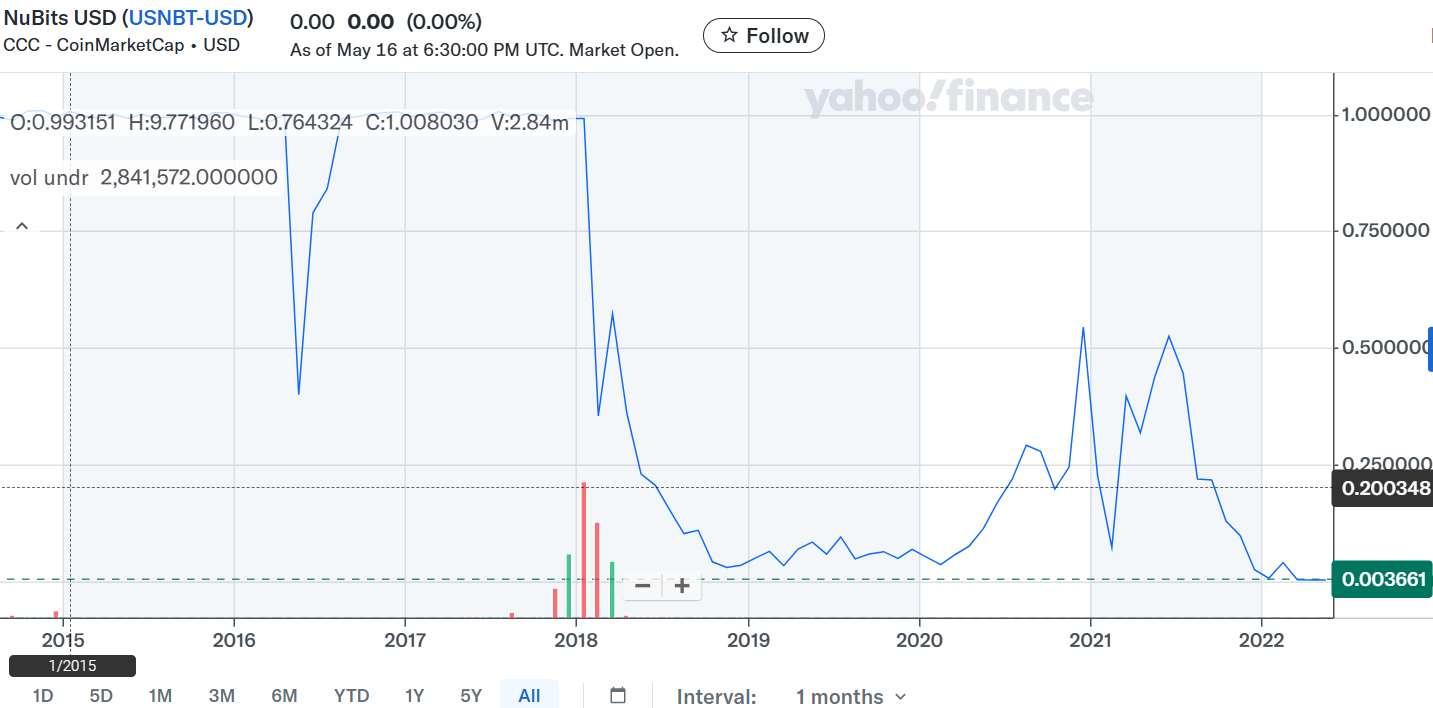
The first incident happened between May and June 2016. NuBits, a Bitcoin-backed stablecoin created after BitUSD, fell to a low of $0.40. Since Bitcoin itself was very volatile, and the stablecoin had limited reserves, its collapse seemed inevitable from hindsight.
The Collapse of NuBits in 2016
Source: Yahoo Finance
NuBits recovered a bit in 2017, but it would later collapse in 2018, never again recovering its peg to the USD.
The second case was BitUSD, the first stablecoin created. It was backed by BitShares, a coin that was very volatile and had not yet been tested. Troubles with BitShares in 2018 led to the collapse of BitUSD. It has not recovered its peg with the USD since then.
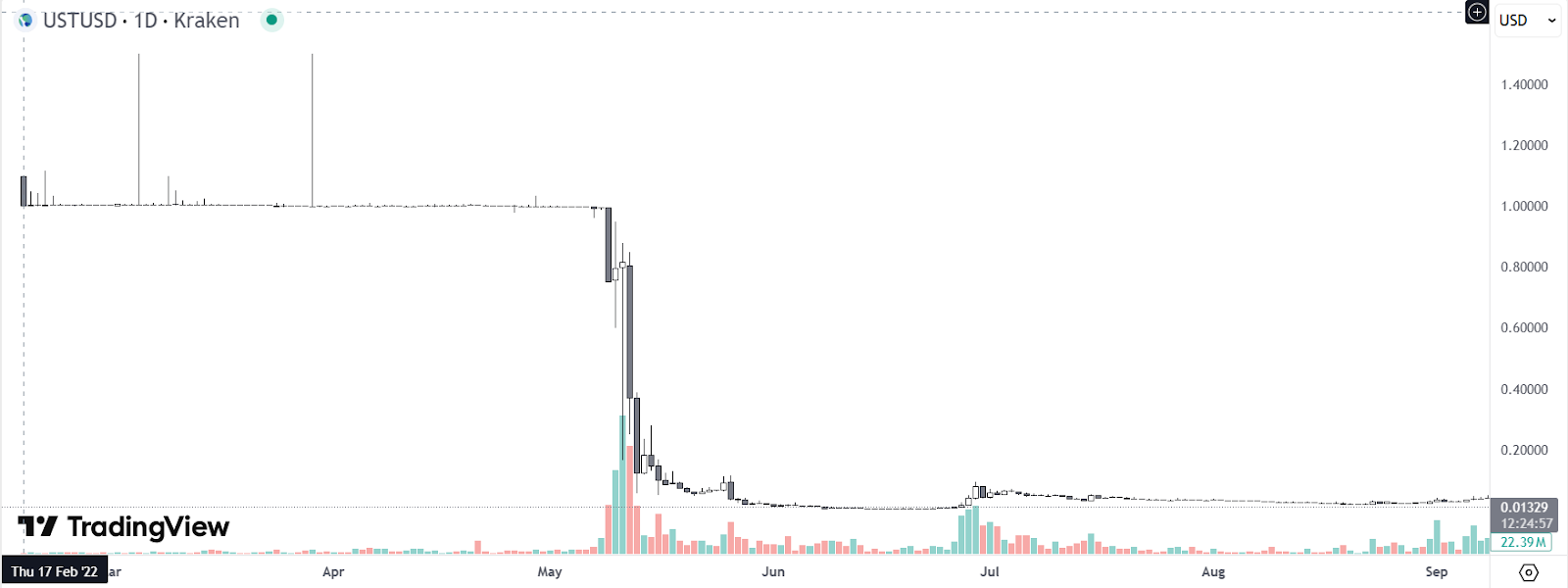
In May 2022, TerraUSD (UST), an algorithmic-backed stablecoin, lost its peg to the US dollar, collapsing to almost zero. This was precipitated by large selloffs of UST on the Anchor platform and the collapse of LUNA, Terra’s native currency.
TerraUSD Collapse in May 2022
Source: Trading View
Users lost over $40 billion in the incident, and it never recovered its peg with the US dollar.
These types of losses are typical after depegging because stablecoins are not insured, and they are unlike central bank digital currencies CBDC) that are backed by central bank reserves.
We have also seen some temporary collapses.
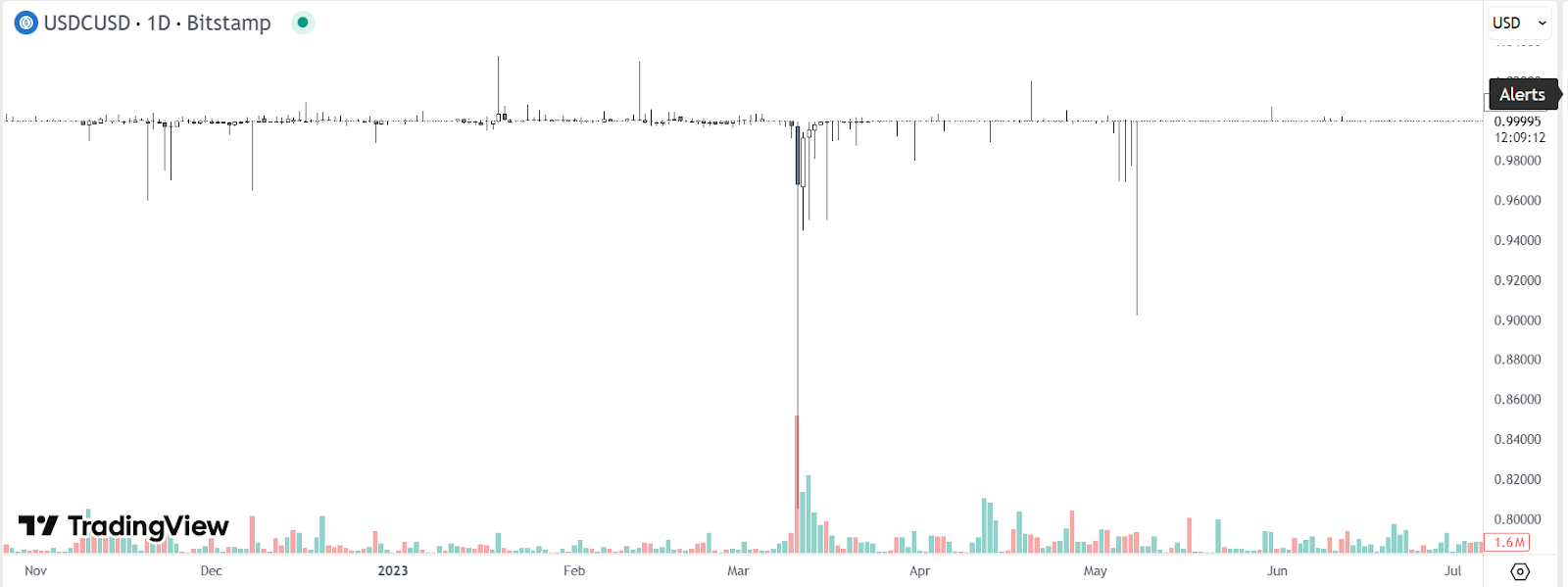
In March 2023, USDC dropped to a low of $0.80 after the collapse of Silicon Valley Bank. This was because about $3 billion of the reserves backing up the stablecoin were held at SVB.
The Temporary Collapse of USDC in March 2023
Source: Trading View
However, USDC would later recover after a few days.
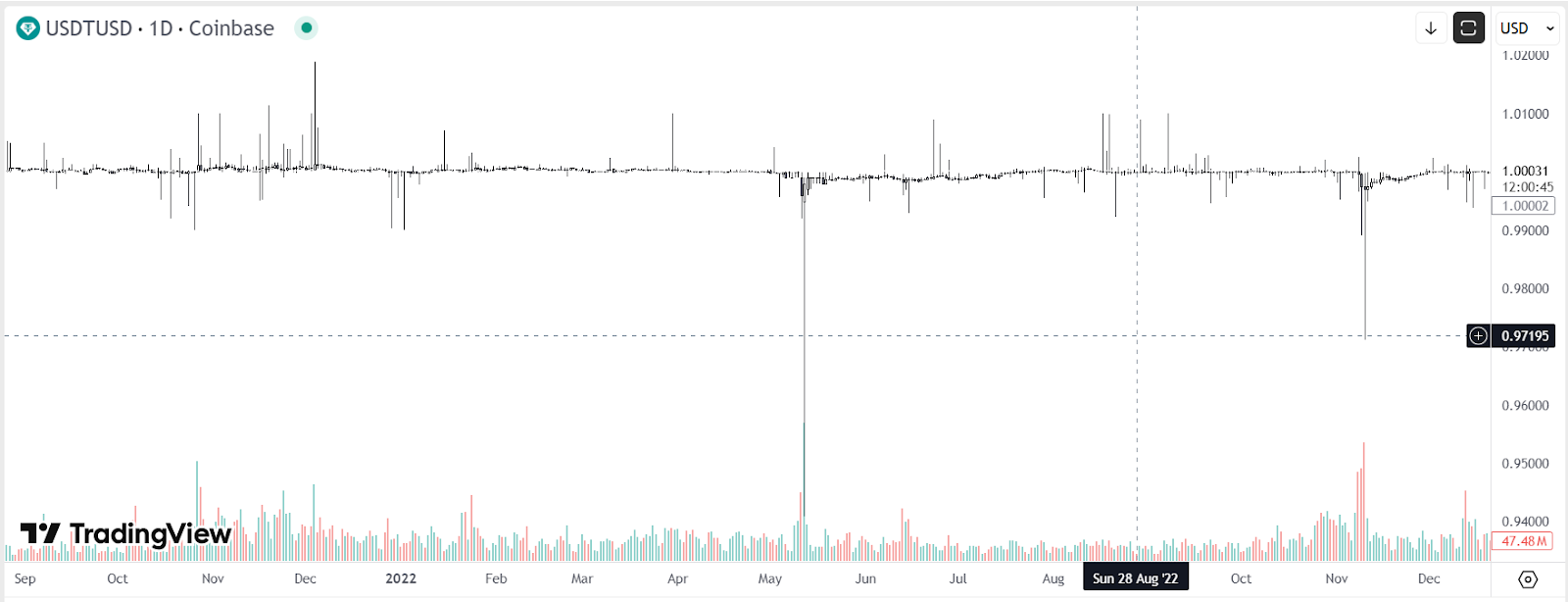
Even USDT, the most valuable stablecoin by market cap, became temporarily untethered from the US dollar in May 2022. It dropped to a low of $0.94 after the collapse of TerraUSD.
Temporary Collapse of USDT in May 2022
Source: Trading View
Other stablecoins that have lost their pegs temporarily include:
- FRAX: An algorithmic-based stablecoin.
- USDD: an algorithmic-based stablecoin
- DAI: a crypto-based stablecoin
- USDD: a fiat-based stablecoin
Failed innovations: A history of fragility
A careful look at the history of stablecoin collapse shows that algorithmic stablecoins have tended to face the greatest risk of collapse.
Though they are a fascinating technology that seeks to remove the need for collateral, they have been open to the risk of the stablecoin equivalent of a bank run. The model depends so much on the perpetuity of demand. Once demand dries up, the peg goes away.
Also, we have seen that crypto-backed stablecoins have suffered from the inherent problems of the crypto assets that underlie them. Even with overcollateralization, collateral value can crash, causing forced liquidations.
Innovations that sought to use a fractional or mixed reserve model (e.g., IRON Finance, which collapsed in 2021) have also experienced the troubles of massive redemption pressure matched with insufficient reserves.
Opaque reserves: A history of uncertainty
It would seem that fiat-based and commodity-backed stablecoins are the only safe options.
However, the SVB case shows that a banking crisis that results in a bank run can put stablecoins in trouble.
Aside from that, users and analysts have questioned whether fiat-based stablecoins truly have the reserves they claim.
Questions about Tether’s reserves intensified in 2018 when it ended its relationship with its auditor (Friedman LLP). Though it would issue a 3-page report affirming that it had sufficient reserves, doubts lingered because the report was not from an independent auditor but a law firm.
Pressured by regulators, Tether would later confirm in 2021 that only a portion of its reserves were held in cash, with others in riskier assets like corporate bonds and commercial papers. This was the reason why there was a temporary depegging after the collapse of FTX in 2022, as users wondered if some of Tether’s reserves were in FTX or Alameda Research.
As we saw above, the collapse of SVB led to a depeg of USDC since a portion of its reserves were held there.
Since then, regulators have attempted to make stablecoins more transparent about their reserves.
Though Tether now publicly publishes details of its reserves, questions continue to be asked about whether stablecoin reserves should be in only cash and US treasury, whether audits are truly independent, and whether stablecoin issuers can survive in low-interest-rate environments.
Regarding the last question, a low-interest environment can lead issuers to seek higher yields in riskier assets by reducing exposure to cash and cash equivalents.
What if troubles in the financial markets cause them to lose money in such higher-yield-higher-risk investments? If such happens, massive redemptions will follow, and the stablecoin will depeg from the relevant fiat currency.
Gold-backed stablecoins face the same issues of transparency and counterparty risk. Many projects lack independent audits of their gold reserves, and in the case where those reserves are held by a third party, there is a custodial risk. Furthermore, physical redemption of commodity-based stablecoins is limited (users have to meet a minimum threshold) and expensive.
Furthermore, given the importance of stablecoins in the world of decentralised finance, any mass redemption and market panic that leads to extended depegging can result in a contagion effect that cripples the entire crypto ecosystem.
Even the traditional financial system won’t be spared since there are now more linkages between them and the crypto market. This is one reason why some analysts argue that stablecoin issuers should be regulated like banks or money market funds.
Regulatory uncertainty: A history of ambiguity
There is still no consistent international regulatory framework for stablecoins.
In Europe, the MiCA stablecoin regulation enables authorities to restrict non-euro stablecoin usage in the region if it interferes with monetary sovereignty, monetary policy, or financial stability, according to the Atlantic Council, a US-based think tank.
Regulators in the US have debated whether stablecoins should be treated as securities, commodities, or payment instruments. Also in the US, the Consumer Financial Protection Bureau has tried to expand Regulation E protections to stablecoins, with no success.
States like New York (with its BitLicense) and California had independent digital asset frameworks, while many states were vague about their approach to stablecoins in particular or digital assets in general. Also, there was no uniform standard for reserve requirements or custodial rules for fiat-backed stablecoins.
However, much progress was made in the US with the signing of the GENIUS Act into law in July 2025. This act will establish a regulatory framework for payment stablecoins in the US.
The STABLE Act (currently pending) also seeks to add stricter consumer protections and a two-year moratorium on algorithmic stablecoins.
Yet, it remains to be seen how these acts will be enforced across relevant financial services regulators.
Another problem exists in relation to Tether Holdings, the issuer of the largest stablecoin. The company is registered in the British Virgin Islands and Hong Kong. Thus, it avoids regulatory oversight by the US and the EU.
This resulted in Binance, Kraken, and Crypto.com blocking spot trading of USDT for European Economic Area users. But the US still allows them to operate without federal oversight.
Furthermore, different jurisdictions have diverse approaches to crypto assets, with some more tolerable of them than others. Even so, we have seen cases of countries changing their stances and updating their regulatory frameworks..
So, how safe are stablecoins?
They remain relatively safer than other types of cryptocurrencies. However, the risks of depegging and regulatory uncertainty remain.
3. Why stablecoins remain relevant in finance
Despite these challenges, stablecoins remain useful.
For example, they support low-cost, real-time, and transparent cross-border payments. Even payment giants like PayPal and Stripe are incorporating stablecoins for global settlements.
At the end of Q1, 2025, about 3% of global cross-border payments were made through stablecoins, according to BVNK, a global stablecoin payments infrastructure provider.
Merchants also accept stablecoins as an alternative payment method on their e-commerce platforms. They support about $30 billion worth of global transactions daily, according to McKinsey and Co.
Businesses also hold stablecoins as cash equivalents, which they can use for real-time settlement and for hedging against local currency volatility.
Crypto enthusiasts also use stablecoins for staking, lending, and yield farming on decentralised finance platforms, and for investing in other crypto assets on both CEXs and DEXs.
For asset owners and managers, stablecoins are a useful way to invest in tokenised real-world assets (RWA), which are becoming an accessible way to invest in alternative assets.
More crypto-friendly asset managers can also deploy stablecoins on DeFi platforms as a way to earn income. This can be helpful for asset managers who need to distribute money regularly to investors.
Similarly, asset managers who invest overseas can use stablecoins to efficiently move funds across jurisdictions. With stablecoins, they don’t have to deal with high fees and banking delays. This can be a more stable option in jurisdictions where banking instability is common. Also, in volatile periods where portfolio rebalancing is time-sensitive, they can be a better alternative to traditional cross-border payments.
Furthermore, asset managers can make international payments for fund operations, vendor settlements, and investor distributions with stablecoins.
4. How should institutional investors approach stablecoins?
However, given the risks associated with them, asset owners and managers have to move cautiously.
There are four things they must consider:
Analyse the risk of depegging
As we have seen, algorithmic-based and crypto-based stablecoins have been more likely to experience depegging. Stablecoins with partial fiat reserves have also faced significant stress when redemption requests increase.
Though fiat-based stablecoins are not invincible, those with full near-cash reserves (usually Treasury bills and money market instruments) are usually the safest stablecoins and are less likely to experience depegging. Even if they do, it will most likely be temporary.
Conduct due diligence on reserve assets
However, fiat-based stablecoins face the problem of transparency about reserve holdings.
Before choosing a stablecoin, asset managers should conduct due diligence to confirm their reserve holdings.
Some key questions to ask include:
- Do they regularly update the details of their reserve holdings?
- Has there been an independent audit report confirming the reserves?
- How many such independent audits have been conducted?
- Are the reserves enough to meet redemption requests if every holder decides to redeem their coins?
- Are the reserves strictly in cash and cash equivalents, or do they include risky assets?
- Are the custodians of the reserves stable financial institutions that users can trust?
Prioritise regulatory-compliant stablecoins
If the issuer of the stablecoin complies with relevant regulatory frameworks, then there is a lower risk that legal troubles will derail it in the future.
The problem with such legal troubles is that they can lead to panic sell-offs and redemptions, which can lead to depegging.
Analyse jurisdictional risk
Before using stablecoins for cross-border payments or for investing in tokenised RWA or overseas assets, asset managers must confirm the state of regulations in particular jurisdictions.
This will help them avoid entering regulatory deep waters.
In the end, asset managers must conduct thorough due diligence before choosing which stablecoins to use or where to use them.
Those who want to be on the safe side need to constantly keep a tab on developments that will help a stablecoin maintain or deviate from its peg.
Asset managers need to be in constant conversations with like-minded investment professionals who can point them to new developments that will help them make better choices regarding the usage of stablecoins.
At the cio investment club, we provide you with a network of asset managers and owners with which you exchange ideas and share updates about stablecoins and the crypto world at large.
We also organise exclusive roundtables and investment breakfasts where you can interact with financial market players and form mutually beneficial connections.
Do you want to be a part of a community where you can get updates on developments in the stablecoin market? Register today to become a part of the cio investment club.
Takeaways
- While pegged to fiat, commodities, or managed through algorithms, stablecoins have still suffered depegging events, reserve opacity, and systemic fragility, raising concerns about their true reliability.
- Fiat- and commodity-backed coins are generally more stable but face transparency and custodial risks, while crypto- and algorithmic-backed models are more prone to collapse due to volatility, overcollateralization issues, or demand shocks.
- With fragmented global oversight, new laws (like the GENIUS Act in the U.S.) aim to bring clarity, but jurisdictional gaps still expose users to legal and operational risks.
- Asset managers should evaluate reserve transparency, regulatory compliance, and jurisdictional risks before using stablecoins for payments, settlements, or investments in tokenised assets.
This document is produced by Instaconnect Limited, trading as cio investment club, a company registered in England & Wales with registration number 15262951.
Instaconnect Limited is neither authorised nor regulated by the Financial Conduct Authority in the United Kingdom nor the Securities and Exchange Commission in the United States of America.
This document is a marketing documentation and is not intended to constitute an invitation or an inducement to engage in any investment activity. It is not intended to constitute investment advice and should not be relied upon as such. It is not intended and none of Instaconnect Limited, its holding companies or any of its or their associates, or any of the participants in the documentation, shall have any liability whatsoever for (a) investment advice; (b) a recommendation to enter into any transaction or strategy; (c) advice that a transaction or strategy is suitable or appropriate; (d) the primary basis for any investment decision; (e) a representation, warranty, guarantee with respect to the legal, accounting, tax or other implications of any transaction or strategy; or (f) to cause Instaconnect Limited to be an advisor or fiduciary of any recipient of this report or other third party.
The content and graphical illustrations contained in this document are provided for information purposes and should not be relied upon to form any investment decisions or to predict future performance. Instaconnect Limited recommends that recipients seek appropriate professional advice before making any investment decision. Although the information expressed is provided in good faith, Instaconnect Limited does not represent, warrant or guarantee that such information is accurate, complete or appropriate for your purposes and none of them shall be responsible for or have any liability to you for losses or damages (whether consequential, incidental or otherwise) arising in any way for errors or omissions in, or the use of or reliance upon the information contained in this document.
To the greatest extent permitted by law, we exclude all conditions and warranties that might otherwise be implied by law with respect to the document, whether by operation of law, statute or otherwise, including as to their accuracy, completeness, or fitness for purpose.
Instaconnect Limited and its logo are proprietary trademarks of Instaconnect Limited and are registered in the United Kingdom. Unauthorised copying of this document is prohibited.
© Copyright Instaconnect Limited 2025