


Britain’s next big investment opportunity may not be another technology unicorn or a fast-growing consumer brand. It could be the road beneath your feet, the electricity grid powering your home, or the data centre processing your next online transaction.
For institutional investors, UK infrastructure is becoming an increasingly important destination for long-term capital. Pension funds, insurers, sovereign investors, and specialist infrastructure managers are looking beyond traditional stocks and bonds toward assets that support the real economy while offering the potential for durable, inflation-linked returns.
But the opportunity is changing. The UK’s infrastructure investment fund landscape is being reshaped by the energy transition, the expansion of digital infrastructure, and renewed government efforts to mobilise private capital.
At the centre of this shift is the National Wealth Fund, the UK government-backed institution designed to help unlock investment in projects that support economic growth and national priorities. Its presence adds another dimension to a market where institutional investors are already weighing infrastructure’s income potential against construction costs, regulation, financing conditions, and the long time horizons involved.
So, where is institutional capital flowing in the UK in 2026? And what does the changing role of government-backed finance mean for infrastructure investment funds and the investors behind them?
In this guide, we will explore the UK's infrastructure fund landscape, from transport and energy to digital networks, and examine the forces shaping where long-term capital goes next. We’ll cover:
- Why institutional investors are increasing infrastructure allocations
- The main types of UK infrastructure investment funds
- How the National Wealth Fund is reshaping the landscape
- What asset owners should watch going into 2027
Do you want to learn more about the strategies that are redefining global financial markets? Sign up now for the cio investment club’s newsletter for regular expert insights.
1. Why institutional investors are increasing infrastructure allocations
The world’s largest institutional investors allocated a record $913.4 billion to infrastructure in 2025, according to Infrastructure Investor, a global infrastructure insights platform. As seen below, this represented a 15% increase from 2024 allocations.
Capital Allocation to Infrastructure by Institutional Investors
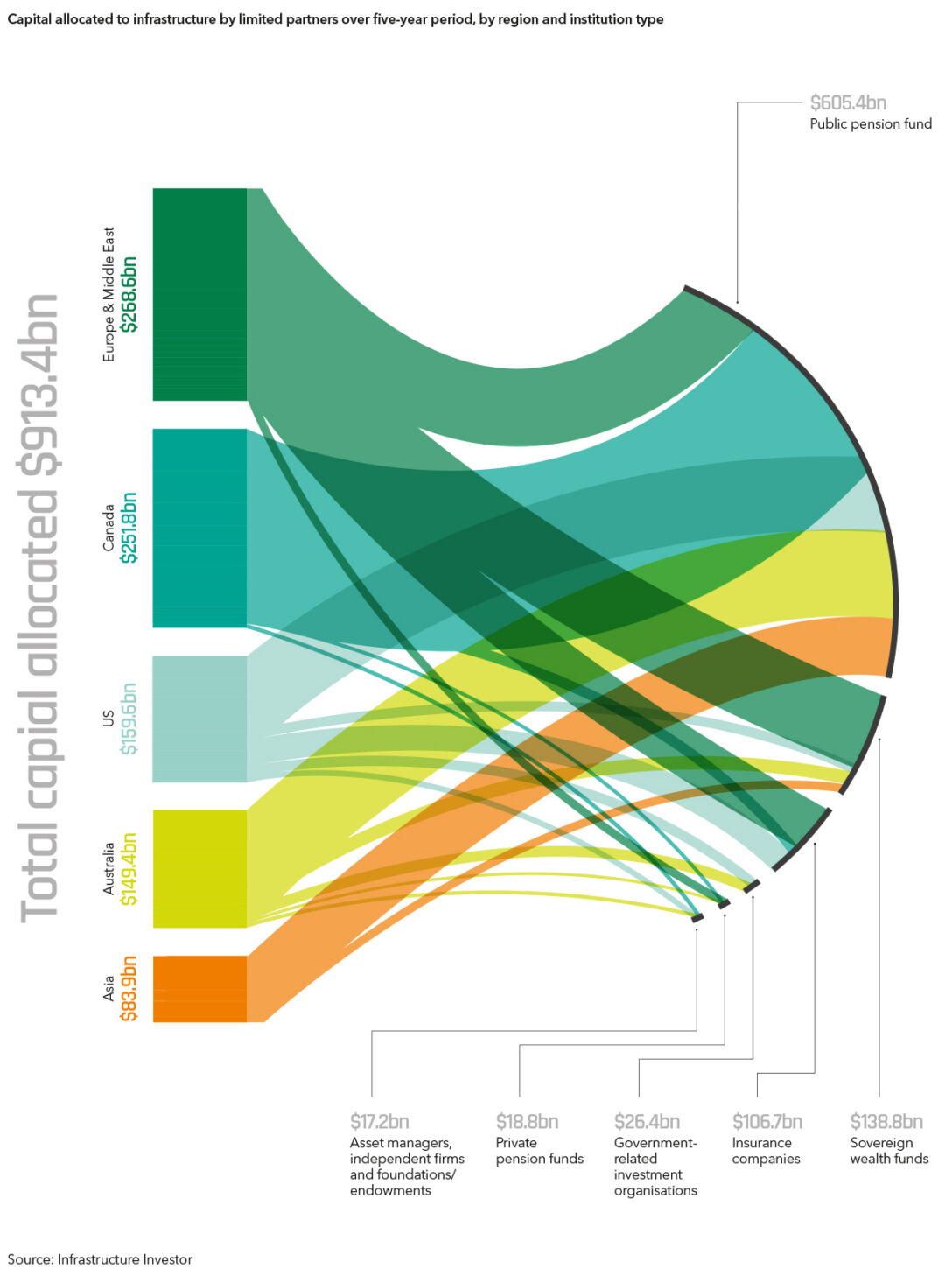
Source: Infrastructure Investor
They also expect the allocation to increase in 2026, as top institutions continue to compete for top spots in the infrastructure allocation ladder.
However, this shift is not limited to the largest institutional investors.
A survey of 500 institutional investors in Asia, Europe, and North America by Aviva Investors, an investment management firm, reveals that infrastructure equity is projected to see the highest growth in net allocations of all private market assets:
Net Allocation Intentions, Private Market Assets
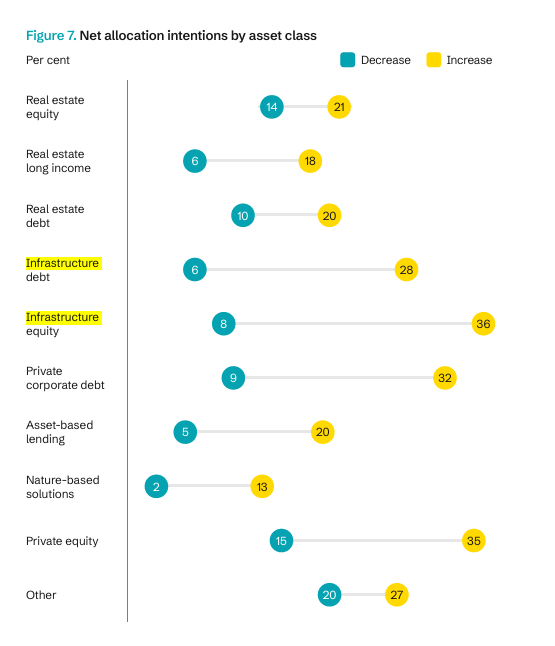
Source: Aviva Investors
Also, infrastructure debt sits behind only private equity and private corporate debt.
But why exactly are institutional investors increasing allocations to this asset class?
Below are some of the most important reasons, according to asset owners and managers.
- Improved return performance: In September 2025, IFM Investors, a global institutional investor, surveyed more than 700 senior investment professionals worldwide.
According to them, the percentage of institutional investors who allocate to infrastructure would increase from 49% in 2025 to 60% in 2030.
One of the reasons for this expected shift is that “investors report that infrastructure equity and debt investments have met or exceeded return expectations in the last 12-18 months.”
A new survey published in January 2026 reveals that the return expectations of infrastructure equity as an asset class continue to rise among institutional investors, as seen below:
Return Expectations of Infrastructure Equity vs Private Equity
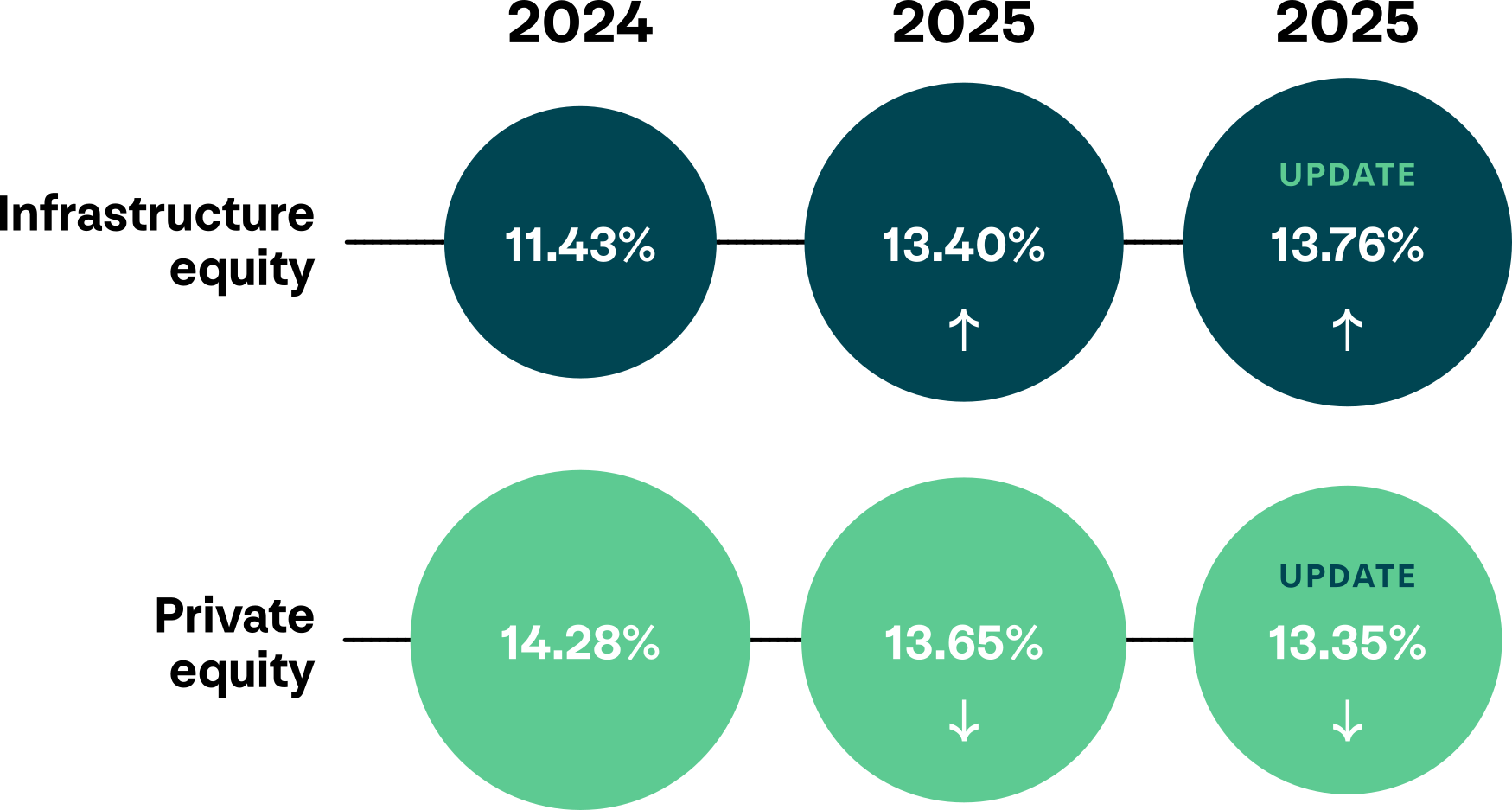
Source: IFM Investors
They also noted that the return expectations of infrastructure debt have risen from 9.59% in 2024 to 9.78% in 2025.
- Inflation protection: Infrastructure assets often have inflation-linked revenues (toll roads or regulated utilities, for example), which makes them attractive in periods of high inflation. This makes them a natural hedge against rising prices.
“Infrastructure assets often benefit from inflation-linked revenues embedded within long-term contractual structures, making them increasingly attractive for liability-driven investors seeking stable real returns,” according to Anthony Curl, Chief Investment Officer of Gravis Capital Management, an investment management firm. “This helps explain why infrastructure is increasingly viewed as one of the highest-conviction areas within private markets.”
- Stability of long-term returns: Infrastructure projects such as energy grids, transport networks, and data centres generate predictable income streams over decades. Pension funds and insurers value this stability for matching long-term liabilities.
“There’s also the appeal of relatively predictable, long-term income, which matters to pension funds and other institutions that have long-term commitments to meet,” according to Deepak Shukla, founder of Pearl Lemon Finance, a business financing company. “The UK is encouraging more pension money into infrastructure as well, with recent reforms aimed at getting more capital invested in UK assets.”
- Support from structural trends and themes: IFM Investors found that 42% of institutional investors allocate money to private markets due to a desire to contribute to energy transition.
Interest in such themes, what Aviva Investors call thematic megatrends, is part of the driving force behind increased infrastructure allocation, according to Curl.
“Infrastructure is benefiting from powerful long-term secular themes that continue to generate large-scale investment demand in the UK and globally,” he noted. “The energy transition, electrification, digital connectivity and rising AI-driven power demand are creating investment opportunities that are relatively independent of the economic cycle.”
- Resilience over different economic and financial environments: Given that many infrastructure assets provide essential services, their demand is relatively stable across the economic cycle. This makes them a resilient asset class, especially in volatile markets.
“With the correct portfolio construction and investment selection, infrastructure assets can bring durable demand that’s resilient to market shifts,” according to Russell Investments, an investment management firm. “For example, investing in data centres focused on the needs of large, creditworthy corporates around data storage, cloud computing capacity and other use cases, are less likely to be impacted by cyclical economic or market gyrations.”
Curl explains this by highlighting the difference between real estate and infrastructure assets.
Higher interest rates have compressed valuations in many real estate sectors, with investors having to refinance a large volume of debt at higher borrowing costs.
In contrast, “Infrastructure tends to have a smoother valuation profile because cash flows are generally more contractual in nature, rather than being directly exposed to economic risk,” he said.
- Support from geopolitics: Many of the thematic megatrends we identified above are also supported by geopolitics, according to Russell Investments.
“Geopolitical volatility is not only increasing investor demand for infrastructure assets; it is urgently reshaping where and how capital is deployed,” they noted. “As energy security, supply chain resilience, and digital sovereignty rise up policy agendas, infrastructure investments that expand capacity and relieve bottlenecks are becoming critical.”
Governments worldwide are prioritising these themes, and this is creating new investment opportunities backed by public policy and incentives.
2. The main types of UK infrastructure investment funds
The UK is one of the places where allocation to infrastructure among institutional investors is expected to increase.
In 2025, 48% of institutional investors surveyed by IFM Investors allocated to infrastructure; this number was projected to increase to 60% between 2027 and 2030.
This establishes that there is a strong interest in infrastructure investing among institutional investors in the UK, supported by the trends we have highlighted above.
How then are they allocating funds to this asset class? We consider some of the popular infrastructure investment funds below:
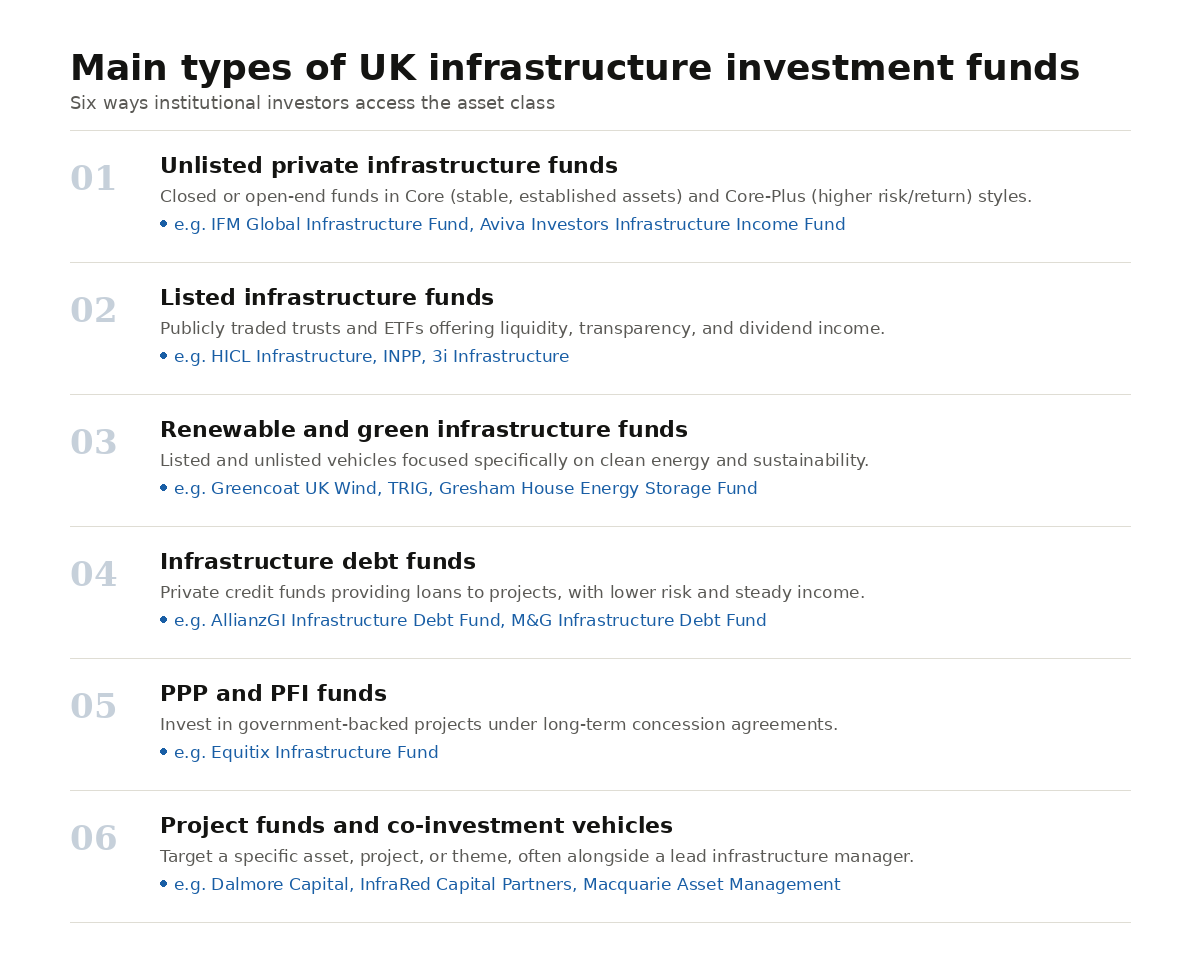
- Unlisted private infrastructure funds: These are closed-end or open-end (unit trusts and open-ended investment companies) private equity-style funds that invest in infrastructure assets.
Some of them (Core Funds) focus on established assets with relatively predictable cash flows and long operating lives – regulated utilities, mature transport networks, and infrastructure businesses with long-term contracts.
On the other hand, Core-Plus funds take on somewhat greater risk in pursuit of higher returns. They may invest in established infrastructure assets that require operational improvements, expansion, or additional capital expenditure.
For example, a fund might acquire an operational transport asset and invest in upgrades that improve efficiency or expand capacity. Similarly, it may target an energy infrastructure business with a stable operating base but opportunities for growth.
Unlisted private infrastructure funds like IFM Global Infrastructure Fund and Aviva Investors Infrastructure Income Fund target long-term stable returns, inflation linkage, and direct asset ownership.
- Listed infrastructure funds: These are publicly traded investment trusts or ETFs listed on the London Stock Exchange.
Popular examples include HICL Infrastructure PLC, International Public Partnerships (INPP), and 3i Infrastructure PLC.
Relative to their unlisted counterparts, these provide more liquidity and transparency, while providing exposure to diversified portfolios of operational assets.
Another attraction of listed infrastructure funds is their potential to provide dividend income.
Investment trusts and infrastructure companies that generate recurring cash flows may distribute part of their earnings to shareholders, making them relevant to investors seeking both income and capital growth.
However, dividend payments are not guaranteed and depend on the performance and distribution policies of the underlying investments.
For investors with interest in the international market, First Sentier Global Listed Infrastructure Fund is a UK-domiciled open-ended investment company (OEIC) that invests in the shares of infrastructure companies (especially utilities, transport, and communication companies) worldwide.
- Renewable and green infrastructure funds: These are listed and unlisted infrastructure funds that focus specifically on clean energy and sustainability.
Examples include Greencoat UK Wind, The Renewables Infrastructure Group (TRIG), and Gresham House Energy Storage Fund.
- Infrastructure debt funds: Infrastructure debt funds are private credit funds providing loans to infrastructure projects.
Examples include AlliaanzGI Infrastructure Debt Fund and M&G Infrastructure Debt Fund.
Infrastructure debt funds provide a lower risk profile, steady income, and diversification from equity exposure.
- Public-private partnership (PPP) and Private Finance Initiative funds: These are funds investing in government-backed projects under long-term concession agreements.
The appeal of these funds lies in their predictable cash flows and strong government counterparties. Examples include Equitix Infrastructure Fund.
- Project funds and co-investment vehicles: Some institutional investors access infrastructure through dedicated project funds or co-investment arrangements.
These vehicles may focus on a particular asset, project, or narrow investment theme. For example, a fund could target renewable energy development, electricity transmission, or a portfolio of digital infrastructure assets.
Co-investment allows institutional investors to invest alongside a lead infrastructure manager, sometimes providing more direct exposure to selected assets.
The structure can be attractive to large asset owners seeking greater control over their infrastructure allocations. However, it may require more investment expertise, due diligence, and capacity to evaluate individual projects.
Investment firms like Dalmore Capital, InfraRed Capital Partners, and Macquarie Asset Management provide this option.
3. How the National Wealth Fund is reshaping the landscape
Russell Investments noted that geopolitics is one of the drivers of the demand for infrastructure funds.
It is, therefore, understandable that many governments across the globe are creating the right environment for infrastructure investing.
In the UK and Europe, this has come in the form of favourable regulation, according to Gravis Capital Management.
“For insurers, regulatory frameworks increasingly favour infrastructure debt, particularly in Europe and the UK,” they noted. “Solvency regimes reward assets with predictable long-term contractual cash flows that align closely with insurers’ liabilities, naturally benefitting infrastructure strategies, although historically more infrastructure debt than equity.”
“In the UK, reforms such as the Mansion House agenda have also been explicitly designed to encourage greater investment into long-term productive assets, including infrastructure,” they noted.
In addition, the UK government is fostering partnerships with private investors to help achieve its aim of providing £725 billion in infrastructure funding between 2025 and 2035, according to the National Infrastructure & Service Transformation Authority.
To accomplish this, the UK government is pursuing multiple strategies, according to IFM Investors:
- Ensuring partnership between its public finance institutions, like the National Wealth Fund and British Business Bank and private investors across a range of areas
- Reforming defined contribution (DC) and local government pension schemes (LGPS) to support infrastructure investments
- Establishing large, sophisticated UK pension funds (as in Canada and Australia) that will invest in infrastructure assets and companies with high growth potential.
Our focus here is on the role that the National Wealth Fund is playing in this regard.
The NWF was established in October 2024 and it is owned and sponsored by HM Treasury. It evolved from the UK Infrastructure Bank and inherited the bank’s infrastructure investment capabilities while receiving a broader mandate to support economic growth and the clean energy transition.
The institution has £27.8 billion in total capitalisation, with a target of mobilising at least £70 billion in private investment. This gives it a potentially significant role in bringing institutional capital into projects (especially in emerging sectors) that might otherwise struggle to secure financing.
Let’s consider some of the roles the NWF plays:
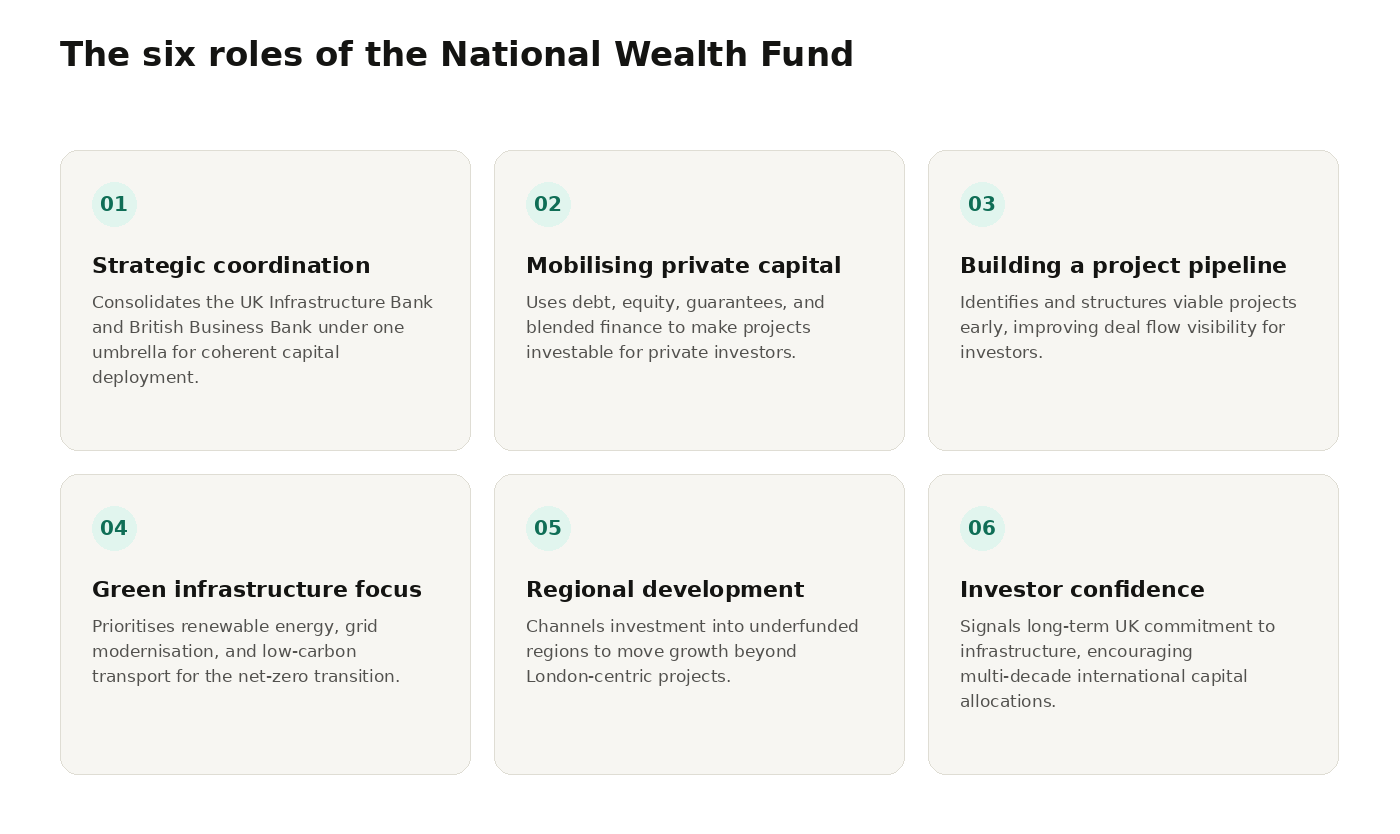
- Strategic coordination: The NWF consolidates investment vehicles like the UK Infrastructure Bank and the British Business Bank under one umbrella.
This unified approach ensures coherent capital deployment across energy, transport, housing, and digital infrastructure.
- Mobilising private capital: The National Wealth Fund is not simply another infrastructure investment fund competing with private asset managers. Its role is to help make projects investable and encourage private investors to participate.
It can do this through debt financing, equity investment, guarantees (to improve the credit profile of projects), and blended finance (government departments and private investors).
This approach matters because infrastructure projects do not always fail to attract capital due to a lack of investor interest. Sometimes the challenge is that the risk profile, financing structure, or development stage does not yet fit the requirements of private capital.
By addressing some of these barriers, the NWF helps bring more projects into the investable pipeline.
- Creating a pipeline of investable projects: One way it supports private investing is by improving deal flow visibility. It does this by identifying and structuring viable projects early, thus giving investors a clearer path to efficiently deploy capital.
- Prioritising green and sustainable infrastructure: The NWF prioritises projects that advance the net-zero transition, including renewable energy generation, grid modernisation, and low-carbon transport.
- Supporting regional development: The NWF also channels investment into underfunded regions to support local economic growth and job creation. It aims to move beyond London-centric projects by pursuing nationwide development.
- Supporting investor confidence and long-term growth: The NWF signals to investors that the UK is committed to infrastructure and positioning itself as a global leader in sustainable infrastructure financing.
This boosts investors’ confidence and makes the UK more attractive to international capital, thus encouraging multi-decade allocations.
The UK Research and Innovation Infrastructure Fund (UKRI Infrastructure Fund) is another government-backed initiative that complements the NWF. It finances large-scale research and innovation infrastructure, such as laboratories, data centers, and clean energy research hubs, that underpin the UK’s long-term competitiveness.
While primarily public-sector led, it opens co-investment opportunities for private capital in digital and sustainable infrastructure.
4. What asset owners should watch going into 2027
Many of the tailwinds that are propelling the surge in allocations to infrastructure equity and debt favour certain infrastructure assets over others.
Therefore, asset owners interested in infrastructure should embrace a strategic approach focusing on where interest is palpable.
Below are some important considerations:
- Green and sustainable infrastructure as NWF priorities: We saw above that the NWF prioritises projects that advance the net-zero transition, including renewable generation, grid upgrades, and low-carbon transport.
Also, we saw how the NWF makes private investing more efficient.
Thus, it makes sense for asset owners to focus on green infrastructure investment funds or infrastructure investment funds that highlight such projects.
- Energy transition, electrification, digital connectivity and rising AI-driven power demand are structural trends: Curl noted above that certain structural themes are propelling the interest in infrastructure investing in the UK and beyond.
Energy transition (and decarbonisation) aligns with what we have seen about green energy and the net-zero transition as the NWF priorities. Electrification and digital connectivity are also relevant since they are in keeping with the NWF’s interest in nationwide (rather than London-centric) development.
Digital connectivity is especially critical, given its role in modern commerce.
“Demand is heavily concentrated in digital infrastructure projects like enterprise data centres, logistics corridors, and clean energy transition grids,” according to Jordan Hutchinson, the founder of Jets and Capital, a networking event series for family offices and high-net-worth individuals. “These facilities underpin foundational modern commerce and consistently draw significant private fund allocations.”
Finally, as AI becomes more entrenched, the power demand from data centres will increase, which will keep projects focusing on electricity (renewable) generation remain on the foreground.
“The primary focus of capital is placed on energy transition and digital assets,” according to Casey TeVault, founder of Casey Buys Houses, a private real estate acquisitions company. “Money is invested in hyperscale data centers, fiber optic networks as well as in solar and wind plants. Financing is given to battery storage facilities and to power transmission lines.”
- Essential services remain key: The resilience of infrastructure assets across different economic environments depends on the essential nature of the underlying service.
However, not all infrastructure projects provide essential services with stable demand.
“Infrastructure assets such as utilities, social infrastructure and core digital networks can provide essential services that remain in demand across all economic environments,” according to Russell Investments. “In contrast, infrastructure sectors with more economic sensitivity face risks in this type of environment, such as airports and toll roads in the transportation sector.”
- Operating assets may become more valuable in inflationary periods: Different types of infrastructure investments react to cost-push inflation in different ways, and this can affect the profitability of any infrastructure investment strategy in inflationary periods.
“Operating assets have in-place physical networks and facilities which allow them to generate revenue without reliance on raw materials,” according to Russell Investments. “For these assets, rising prices of construction inputs limit new capacity and the competitive positioning of the assets can strengthen. In contrast, the returns of greenfield development strategies can be highly sensitive to input costs rising during the development process and are more vulnerable to rising costs in supply chains.”
While existing infrastructure tends to benefit when costs rise, new projects are more vulnerable to inflation.
- Energy, supply chains and digital assets as nationally strategic infrastructure: As we have seen, geopolitics is another driver of interest in infrastructure investment funds in the UK.
Therefore, nationally strategic or critical infrastructure like energy, supply chains, and digital assets will continue to be relevant going forward.
Institutional investors interested in UK infrastructure investment funds can benefit strongly from ongoing conversations with asset managers with expertise in the UK infrastructure investment space.
At cio investment club, we provide an avenue where such conversations can take place by connecting you with asset managers and other finance professionals in the UK and across the globe.
We also organise exclusive roundtables and investment breakfasts where you can interact face-to-face with other experts.
Our Infrastructure Debt Investment Breakfast will be held on Thursday 12th November 2026, 08:45-10:45 at the Ten Trinity Club, Four Seasons, 10 Trinity Square, London EC3N 4AJ.
You can register for this event on the website or contact us for more information.
Do you want to become a member of an investment community that will help you better spot opportunities in private markets? Register now to become a part of the cio investment club.
Takeaways
- Infrastructure equity and debt are attracting increasing interest from pension funds, insurers, and other institutional investors seeking long-term returns, inflation protection, and portfolio resilience.
- Unlisted private funds, listed infrastructure trusts, renewable energy funds, infrastructure debt funds, and co-investment vehicles offer different ways to access the sector.
- Government-backed financing is supporting infrastructure investment by helping structure projects, attract private investors, and advance strategic priorities such as clean energy and digital infrastructure.
- As asset owners look toward 2027, energy transition, electrification, AI-driven power demand, and resilient infrastructure assets are shaping allocation decisions.
This document is produced by Instaconnect Limited, trading as cio investment club, a company registered in England & Wales with registration number 15262951.
Instaconnect Limited is neither authorised nor regulated by the Financial Conduct Authority in the United Kingdom nor the Securities and Exchange Commission in the United States of America.
This document is a marketing documentation and is not intended to constitute an invitation or an inducement to engage in any investment activity. It is not intended to constitute investment advice and should not be relied upon as such. It is not intended and none of Instaconnect Limited, its holding companies or any of its or their associates, or any of the participants in the documentation, shall have any liability whatsoever for (a) investment advice; (b) a recommendation to enter into any transaction or strategy; (c) advice that a transaction or strategy is suitable or appropriate; (d) the primary basis for any investment decision; (e) a representation, warranty, guarantee with respect to the legal, accounting, tax or other implications of any transaction or strategy; or (f) to cause Instaconnect Limited to be an advisor or fiduciary of any recipient of this report or other third party.
The content and graphical illustrations contained in this document are provided for information purposes and should not be relied upon to form any investment decisions or to predict future performance. Instaconnect Limited recommends that recipients seek appropriate professional advice before making any investment decision. Although the information expressed is provided in good faith, Instaconnect Limited does not represent, warrant or guarantee that such information is accurate, complete or appropriate for your purposes and none of them shall be responsible for or have any liability to you for losses or damages (whether consequential, incidental or otherwise) arising in any way for errors or omissions in, or the use of or reliance upon the information contained in this document.
To the greatest extent permitted by law, we exclude all conditions and warranties that might otherwise be implied by law with respect to the document, whether by operation of law, statute or otherwise, including as to their accuracy, completeness, or fitness for purpose.
Instaconnect Limited and its logo are proprietary trademarks of Instaconnect Limited and are registered in the United Kingdom. Unauthorised copying of this document is prohibited.
© Copyright Instaconnect Limited 2026