


For years, the classic portfolio playbook was built around a simple idea: combine equities for growth and bonds for stability. But that formula starts to look a lot less reassuring when stocks and bonds move in the same direction, correlations rise, and traditional diversification offers less protection than investors expect.
This is where liquid alternatives are gaining attention. Designed to bring some of the strategies traditionally associated with hedge funds into more accessible and liquid investment structures, they give institutional investors another way to pursue returns while managing portfolio risk.
From long/short strategies and market-neutral approaches to macro trading and alternative credit, liquid alternative investments can respond to market conditions in ways traditional asset classes cannot.
However, liquid alternatives are not a free lunch, and asset owners and managers must be aware of the risks they carry. In this article, we consider the roles of liquid alternatives, the inherent risks, and how to manage those risks while enjoying the benefits.
We’ll cover:
- Why are institutional investors interested in liquid alternatives?
- Liquid alternatives and portfolio construction
- The risks of investing in liquid alts
- Investing in liquid alternatives: What institutional investors should know
Do you want to learn more about the opportunities available in various financial markets across the globe? Sign up now for the cio investment club’s newsletter for regular expert insights.
1. Why are institutional investors interested in liquid alternatives?
It is no longer news that the search for higher risk-adjusted returns, more diversified portfolios, and inflation protection has led investors, retail and institutional, to take private markets and alternative assets more seriously.
“Institutional investors are steadily increasing allocations to private markets, particularly infrastructure, private equity, and real assets, signaling a structural shift toward alternatives,” according to Jan Erik Saugestad, CEO of Storebrand Asset Management. “At its core is a need for deeper exposure to the real economy, alongside more resilient and diversified returns.”
However, private markets have always been defined by liquidity risk.
“Unlike public markets where assets can be quickly bought or sold, private market investments often involve longer holding periods and can be harder to sell quickly,” according to BlackRock. “This could tie up your capital for extended periods.”
Liquid alternatives provide an alternative. With them, investors can both diversify their portfolios and enjoy higher returns without sacrificing liquidity.
At their core, liquid alts apply alternative investment strategies (long/short equity, global macro, event-driven, managed futures, relative value arbitrage, equity market neutral, and multi-strategy, among others) traditionally associated with hedge funds and private equity within liquid, easily tradable, and regulated formats.
Liquid alternative funds are offered as mutual funds, exchange-traded funds (ETFs), and closed-end funds, which makes it easier for investors to trade them.
But why are institutional investors interested in this asset class?
There are at least three reasons:
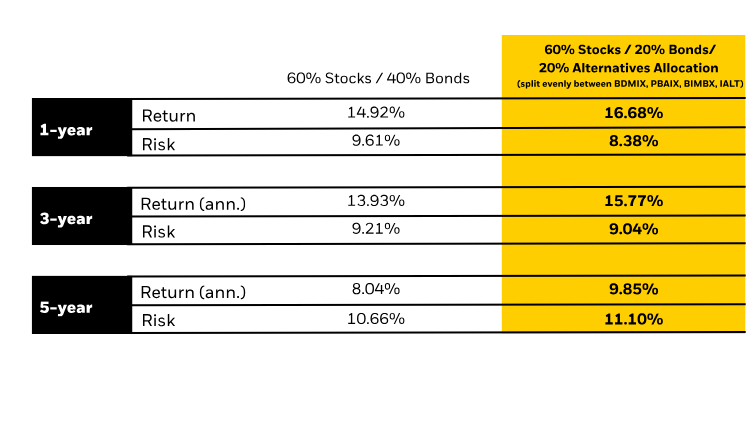
- Higher returns: One way to see the return amplification impact of liquid alternatives is to compare a portfolio that contains them with a traditional 60/40 bond portfolio.
As seen below, as of June 30, 2026, a 60/20/20 portfolio, with a 20% allocation to liquid alternatives, outperforms a traditional 60/40 portfolio over one-year, three-year, and five-year horizons.
Comparing a Portfolio with Liquid Alts With a Traditional Portfolio
Source: BlackRock
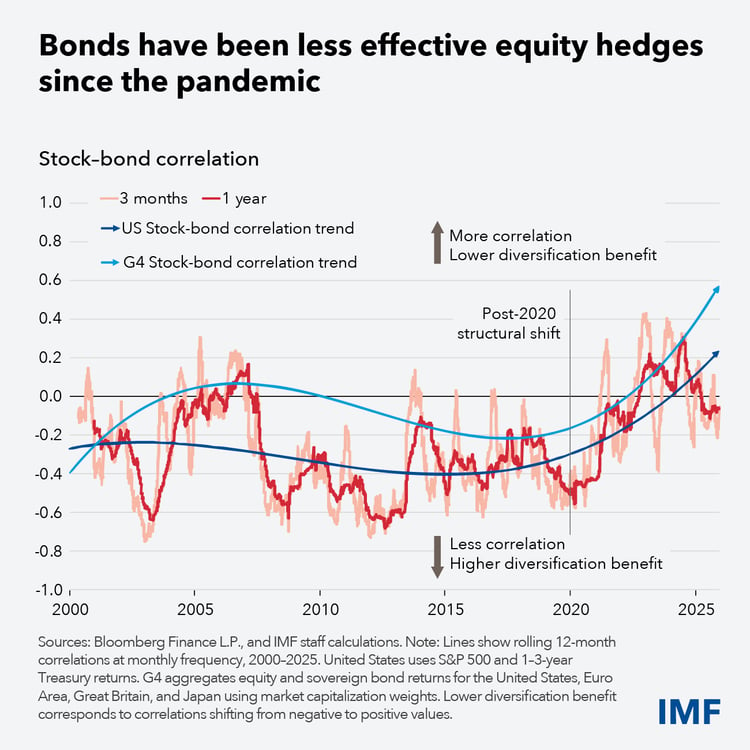
- Lower risk: It is no longer news that stocks and bonds have been moving more in tandem since the structural shifts that resulted from the COVID-19 pandemic. Consequently, bonds have been less effective as hedges against equity exposure, as seen in the chart below:
Rising Stock-Bond Correlation Since COVID-19
Source: International Monetary Fund
“Since the start of the pandemic period—with supply shocks that fueled inflation—bonds have become less effective in cushioning volatility in stocks,” according to the IMF. “Instead of offsetting equity risk, bonds are increasingly moving in tandem with stocks. This shift is particularly pronounced during sharp market selloffs, with profound implications for investors and policymakers alike.”
It is understandable then that investors are in search of alternatives that can provide true diversification.
“In a world where stocks and bonds can fall together, institutions want return streams that are not fully dependent on equity markets or interest rates,” said Firdaus Syazwani, founder of Dollar Bureau, a personal finance education platform.
Liquid alternatives are one of the solutions that institutional investors have adopted.
“By targeting differentiated sources of return that are less reliant on broad market direction, they can exhibit low correlations to traditional stocks, bonds, and even other alternatives,” according to BlackRock.
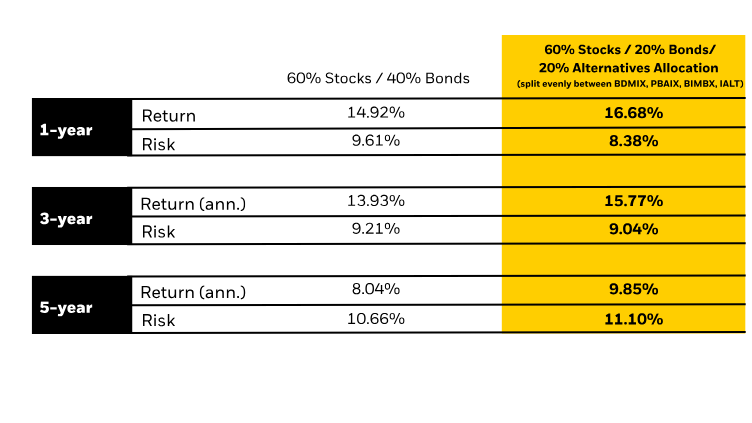
The other side of this chart shows that this lower correlation results in a lower risk profile for portfolios that include liquid alternatives:
Comparing a Portfolio with Liquid Alts With a Traditional Portfolio
Source: BlackRock
Over the one-year (June 30, 2025 - June 30, 2026) and three-year (June 30, 2023 - June 30, 2026) horizons, the portfolio with liquid alts recorded lower risk. Only over the five-year (June 30, 2021 - June 30, 2026) horizon does the traditional portfolio provide lower risk.
- Return consistency: As economies prioritize macroeconomic resilience, investors have also focused their attention on building portfolios that can perform well in different market regimes.
This often requires diversifying sources of return
“If the goal is to build a portfolio that is genuinely resilient across a wide range of economic environments – rather than one that merely appears stable on quarterly statements – investors need to look beyond how asset classes are packaged and instead focus on return drivers that are fundamentally different in nature,” according to GMO, an investment management firm.
This is exactly what liquid alternatives provide.
“As a long-term allocation, a liquid alternative aims to generate returns across a range of market environments with relatively controlled volatility,” said BlackRock.
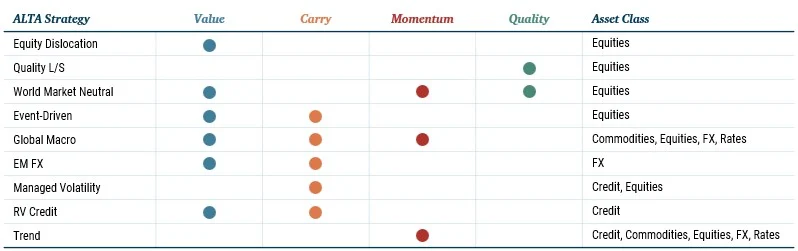
For example, the GMO Alternative Allocation Fund combines multiple liquid alt strategies, with each strategy investing in different asset classes and pursuing diverse investment styles (value, quality, carry, momentum).
Composition of GMO Alternative Allocation Fund
Source: GMO
- Liquidity: As said above, liquid alternatives solve the illiquidity problem associated with private markets.
This illiquidity makes private markets inflexible, which makes it difficult to rebalance portfolios when risk assets are selling off. Many investors end up selling their public assets at losses when liquidity is required.
“Alternatives with daily liquidity seek to avoid these constraints,” according to GMO. “They were designed to allow investors to rebalance efficiently, respond to changing conditions, and maintain flexibility without structural impediments. In an environment where shocks can arrive without warning, we view flexibility not as a convenience – but as an essential.”
2. Liquid alternatives and portfolio construction
We have considered the four aims of liquid alternative investments – higher absolute returns, lower risk, return consistency (and downside protection), and liquidity. Now we turn to how alternative mutual funds and ETFs achieve these aims by looking at their portfolio construction strategies.
Diversifying return sources
One common technique used by managers of liquid alternative funds is to take both long and short positions. The long/short strategy allows these funds to bet on both assets they expect to outperform and those they expect to underperform.
With such flexibility, these funds rely less on broad market direction (since they can profit under different market directions), and more on “identifying relative performance differences,” as BlackRock puts it.
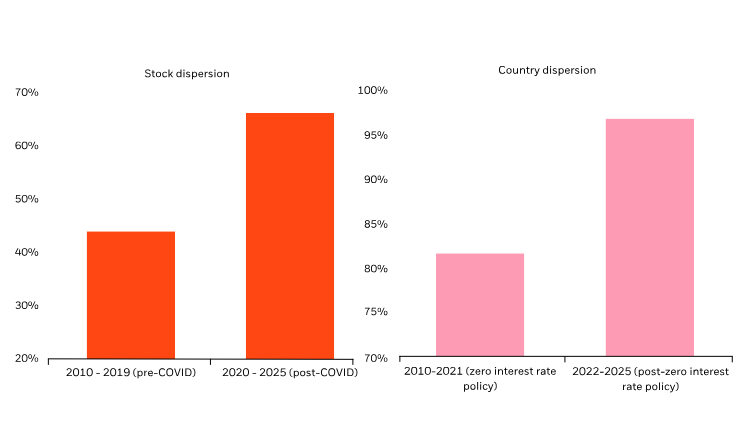
Interestingly, BlackRock observes that differences in relative performance, also known as dispersion, are increasing within and across markets, as seen below:
The Rise of Dispersion Within and Across Markets
Source: BlackRock
In other words, the performance difference between leaders and laggards within given markets and across different markets has become wider in recent years. And this provides more opportunities for long/short strategies to provide value.
“Market environments with heightened dispersion can present opportunities for relative value and active strategies to target return,” said BlackRock.
Similarly, GMO notes that many liquid alternative strategies harvest “returns rooted in market structure and investor behavior.” These strategies are categorized as “alternative risk premia,” since they compensate investors for exposure to risks that are difficult to hold consistently.
They include merger arbitrage, which earns a spread for bearing the risk that an announced M&A may fail; carry strategies, which harvest yield differentials across currencies, rates, or commodity futures curves; volatility selling, which earns a premium from investors paying for insurance against abrupt market moves; and trend-following, which benefits from the tendency of assets to maintain a given trend.
Pursuing alpha strategies
Similarly, alternative investment funds seek to generate returns through alpha strategies. These include relative mispricings, fundamental security selection, and event-driven catalysts, according to GMO.
In other words, these funds profit from portfolio managers’ skills and not only directional bets.
Managing exposure with derivatives
Liquid alternatives tend to use derivatives a lot, for both risk management and directional bets
“They use tools like options, swaps, and futures to protect against market downturns,” according to IFA Magazine, a financial planning and news platform. “They also utilise advanced models to assess exposure to various risk factors, such as market risk, credit risk, liquidity risk, and others, enabling managers to identify and mitigate potential vulnerabilities in their portfolios.”
Regarding directional bets, BlackRock notes that derivatives can be a capital-efficient way to gain exposure to the market due to the availability of leverage.
“Derivatives, like options, forwards, futures and swaps, are another investment tool often used in liquid alternatives, enabling managers to express investment views across asset classes such as equities, interest rates, credit, currencies, and commodities. Because derivatives allow exposure to be established using only a portion of invested capital, they are a potentially capital-efficient way to gain market exposure.”
Capturing niche opportunities
As said above, liquid alternatives make typical hedge fund strategies available to institutional and retail investors in liquid structures like ETFs and mutual funds.
Consequently, they provide access to niche strategies outside the scope of long-only investing.
Liquid alts portfolio managers use derivatives to access specific market segments like volatility, credit spreads, and interest-rate differentials. Also, they go beyond equities to gain exposure to fixed income, currencies, and commodities.
Furthermore, these funds can exploit market inefficiencies and pursue dynamic risk management strategies that are otherwise difficult to execute through traditional public funds.
3. The risks of investing in liquid alts
Though liquid alts are solving important challenges for institutional investors, they are not without their risks.
Below are some of the important ones:
- Performance differential: GMO noted that liquid alternatives pursue alpha strategies and that the success of these depends on the fund manager. This introduces a performance differential, which means funds pursuing similar strategies can have disparate results.
“Liquid alternatives span multiple strategy categories, and results can vary significantly even among strategies with similar mandates,” according to BlackRock.
- Complexity: A look at GMO’s liquid alternatives fund shows that they combine a variety of strategies, each with its investment style and asset class.
- Market volatility: Though liquid alts can diversify risk, they can themselves experience sharp swings, depending on the underlying strategies.
- Leverage: Though leverage can amplify returns, it can also magnify risks. This risk can be very significant, given that liquid alternative strategies often rely on derivatives.
“Like traditional investments, liquid alternative investments may be exposed to factors like economic risks and price volatility,” according to Fidelity Investments. “However, these investments can be more speculative than many traditional mutual funds, since they often hold long and short positions, can use derivatives, and can deploy leverage.”
- Higher fees: Though they are structured as mutual funds and ETFs, liquid alternatives have higher expense ratios.
4. Investing in liquid alternatives: What institutional investors should know
Institutional investors who want to invest in liquid alternatives should adopt an approach that aligns with the risks and benefits of the asset class.
Below are some important pointers:
- Using liquid alternatives as satellite allocation: Liquid alternatives are designed as satellite allocations to complement core holdings in equities and fixed income.
Their non-correlated revenue streams, diversification benefits, and tactical flexibility make them appropriate to support core portfolios in this way.
- Starting with a portfolio objective: Institutional investors who already have a traditional multi-asset portfolio and want to allocate to liquid alts have to decide whether to reduce allocation to bonds or equities.
The former makes sense if the goal is return enhancement, while the latter is appropriate for reducing overall volatility.
Consequently, before investing in liquid alternatives, institutional investors should clarify their prevailing portfolio objectives.
“Institutions should start with the portfolio problem they are trying to solve, not with the product,” according to Syazwani. “Is the goal lower volatility, inflation protection, crisis protection, lower equity beta, or a new return source? From there, they should size the allocation modestly, stress-test it across different market environments, and judge it against the role it is meant to play.”
- Prioritizing manager selection: As we have seen, performance differentials make manager selection an important part of liquid alternatives investing. “Thorough due diligence and thoughtful fund selection is critical,” according to BlackRock.
Factors to consider include track record across market cycles (especially risk-adjusted returns), investment philosophy, risk management protocols, operational infrastructure, transparency in reporting, expertise, and interests alignment.
One important aspect is stress-testing liquid alternatives funds to see how they might hold up under extreme scenarios.
“I'd also stress-test the investment under difficult conditions rather than judging it purely on historical performance,” said Deepak Shukla, the CEO of Pearl Lemon Capital, a business and property financing company. “The biggest mistake is treating 'alternative' as synonymous with 'safer'. It isn't.”
- Diversifying across strategies: Diversifying across various liquid alternative strategies is a good way to achieve “portfolio robustness,” according to AQR Funds, an investment management firm.
This will help minimize strategy-specific risk and enhance return consistency. For example, while managed futures may thrive in trending markets, event-driven strategies may perform better in stable or ranging environments.
Also, equity beta, interest-rate sensitivity, market volatility, and momentum can all be balanced with a multi-strategy exposure.
Asset owners and managers who are new to the world of liquid alternatives can benefit from learning how others have approached this asset class.
At cio investment club, we provide a platform where asset managers, asset owners, and other financial market experts can interact and exchange ideas about broader market trends and specific financial markets.
We also organize exclusive roundtables and investment breakfasts where experts can network and collaborate on mutually beneficial projects.
Do you want to become a member of an investment community that will help improve your investment decisions? Register now to join the cio investment club.
Takeaways
- Liquid alternatives offer diversification beyond the traditional 60/40 portfolio by accessing return streams that are less dependent on equity and interest-rate movements.
- Liquidity is a major advantage, allowing institutions to rebalance and respond to market conditions without the lock-up associated with many private-market investments.
- Liquid alts come with meaningful risks, including leverage, strategy complexity, volatility, manager risk, and higher fees.
- Successful allocation starts with the portfolio objective, followed by careful manager selection, stress testing, and diversification across alternative strategies.
This document is produced by Instaconnect Limited, trading as cio investment club, a company registered in England & Wales with registration number 15262951.
Instaconnect Limited is neither authorised nor regulated by the Financial Conduct Authority in the United Kingdom nor the Securities and Exchange Commission in the United States of America.
This document is a marketing documentation and is not intended to constitute an invitation or an inducement to engage in any investment activity. It is not intended to constitute investment advice and should not be relied upon as such. It is not intended and none of Instaconnect Limited, its holding companies or any of its or their associates, or any of the participants in the documentation, shall have any liability whatsoever for (a) investment advice; (b) a recommendation to enter into any transaction or strategy; (c) advice that a transaction or strategy is suitable or appropriate; (d) the primary basis for any investment decision; (e) a representation, warranty, guarantee with respect to the legal, accounting, tax or other implications of any transaction or strategy; or (f) to cause Instaconnect Limited to be an advisor or fiduciary of any recipient of this report or other third party.
The content and graphical illustrations contained in this document are provided for information purposes and should not be relied upon to form any investment decisions or to predict future performance. Instaconnect Limited recommends that recipients seek appropriate professional advice before making any investment decision. Although the information expressed is provided in good faith, Instaconnect Limited does not represent, warrant or guarantee that such information is accurate, complete or appropriate for your purposes and none of them shall be responsible for or have any liability to you for losses or damages (whether consequential, incidental or otherwise) arising in any way for errors or omissions in, or the use of or reliance upon the information contained in this document.
To the greatest extent permitted by law, we exclude all conditions and warranties that might otherwise be implied by law with respect to the document, whether by operation of law, statute or otherwise, including as to their accuracy, completeness, or fitness for purpose.
Instaconnect Limited and its logo are proprietary trademarks of Instaconnect Limited and are registered in the United Kingdom. Unauthorised copying of this document is prohibited.
© Copyright Instaconnect Limited 2026