


For more than a decade, value investing has looked like the forgotten strategy of the stock market.
Investors who searched for undervalued companies were left behind by those who chased growth stocks, which seemed to be on unstoppable momentum, particularly in the technology sector. Cheap valuations were easy to dismiss when investors were willing to pay a premium for future growth.
But the trend may be changing.
Higher interest rates have made investors less willing to pay almost any price for distant growth. Tech valuations, after years of expansion, are facing greater scrutiny. And as markets have become more focused on earnings, cash flow, and current performance, some of the qualities that value investors have championed for decades are suddenly back in fashion.
But is value investing truly making a comeback, or is this just another temporary rotation?
In this article, we will explore the factors leading to a reignition of interest in value stocks and how institutional investors should approach them. We’ll cover:
- Why is value investing making a comeback?
- Where are value investors finding opportunities in 2026?
- Is the renewed interest in value investing sustainable?
- How should institutional investors approach value investing?
Do you want to learn more about the strategies that are redefining global financial markets? Sign up now for the cio investment club’s newsletter for regular expert insights.
1. Why is value investing making a comeback?
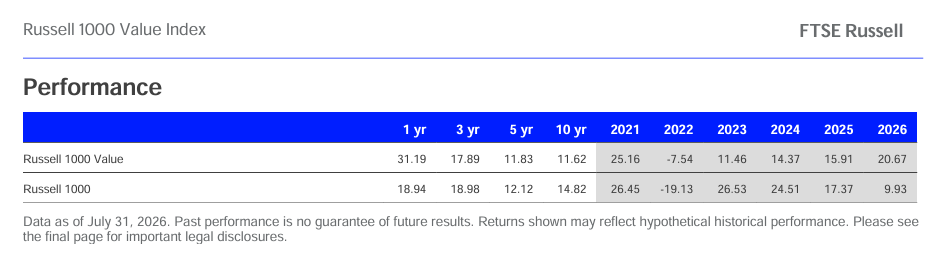
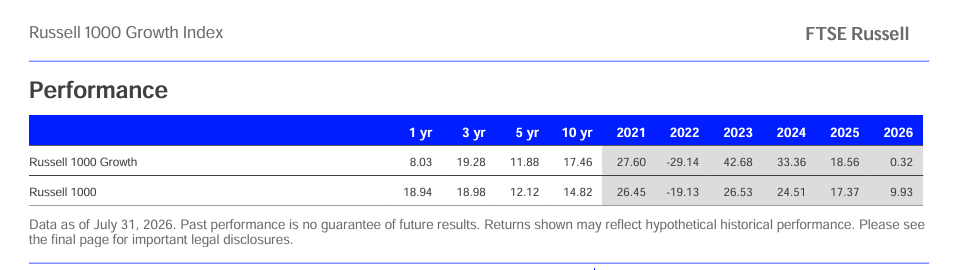
The battle between value stocks and growth stocks has gone in favour of the latter in recent years. As the chart below shows, the FTSE Russell Growth Index outperformed the FTSE Russell Value Index in 2021, 2023, 2024, and 2025.
Russell 1000 Value Index Performance
Source: FTSE Russell
Russell 1000 Growth Index Performance
Source: FTSE Russell
More importantly, the growth stocks index outperformed the value stocks index over 3-year, 5-year, and 10-year time horizons.
However, over a 1-year time horizon, the Russell 1000 Value Index outperformed the Russell 1000 Growth Index by a significant margin (31.19% to 8.03%). We see the same pattern with yield-to-date performance as of July 31, 2026: the value index has returned 20.67%, while the growth index returned a measly 0.32%.
But what happened in 2025 and 2026 that is causing this outperformance of value investing strategies?
Below are some important factors:
- Weaker performance of the Mag 7: As said above, technology stocks propelled the outperformance of growth stocks in recent years. This is especially evident in the concentration of the S&P 500 (by market cap) in the Magnificent 7 companies.
In 2023, seven of these stocks outperformed the S&P 500 Index, according to J.P Morgan. Six of them still outperformed in 2024. However, only two of them outperformed in 2025, and the scale of outperformance had shrunk significantly.
At the time of writing, only three of the Mag 7 stocks have higher yield-to-date (YTD) returns than the S&P 500 Index, with two even posting negative returns.
- Earnings growth: In 2024 and 2025, the S&P 500 Index recorded double-digit earnings growth, according to FactSet. Also, 79% of the index’s YTD return in 2025 was attributable to earnings growth, according to J.P Morgan.
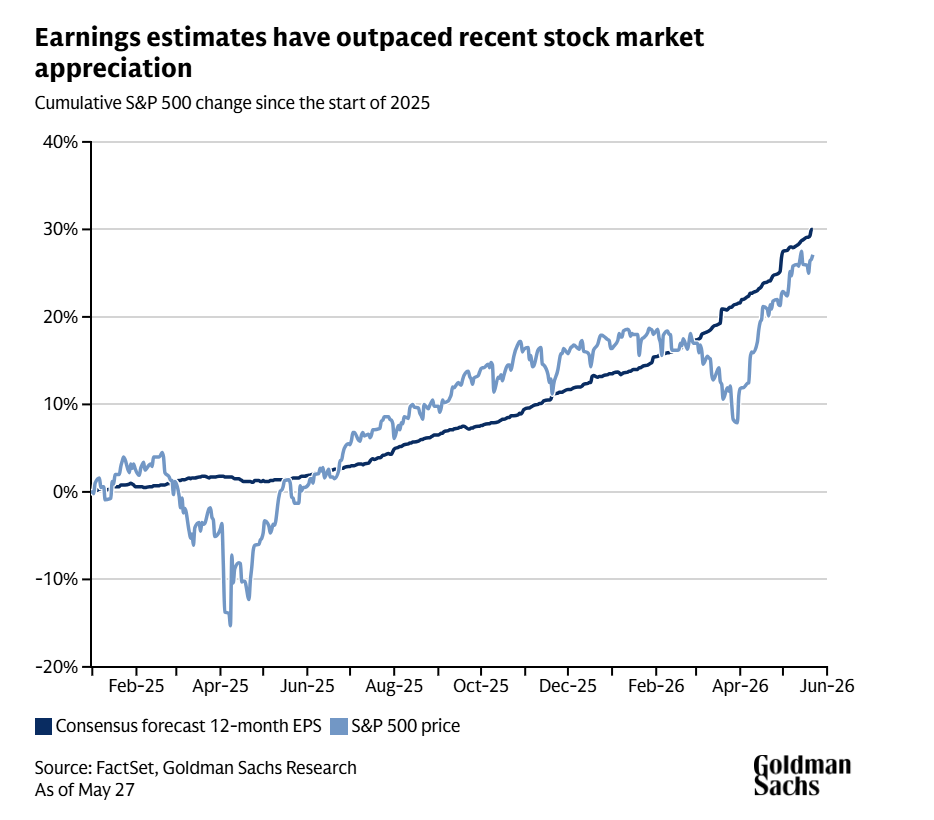
The strong earnings growth has continued in 2026, leading Goldman Sachs to forecast higher returns for the index this year. As seen below, earnings estimates are already outpacing stock price appreciation:
Earnings Estimates vs Stock Market Appreciation
Source: Goldman Sachs
When corporate profits rise across multiple sectors in this way (not just concentrated in tech stocks), cyclical and asset-heavy companies see stronger earnings rebounds. Since many of these companies often trade at lower valuations (which means they belong in value indices), modest profit growth drives outsized price appreciation, causing value indices to rise.
J.P. Morgan also believes that this earnings growth has been supported by a pro-business climate in the US.
“The policy backdrop is not only favourable from a fiscal and monetary perspective, but corporate tax changes from the OBBBA, which postpone certain tax liabilities, may incentivise capex today, coinciding with the AI capex boom. In addition, a more pro-business climate coupled with lower rates has spurred capital markets activity, benefiting financials, which facilitate this activity.”
Also, beyond the US, earnings growth has been supported in European equities by defence spending, rising demand for commercial aircraft, and recovery in agricultural commodity prices, according to AllianceBernstein, an investment management company.
- Higher inflation expectations: US tariff policy and the US-Iran-Israel war have both pushed inflation expectations upward.
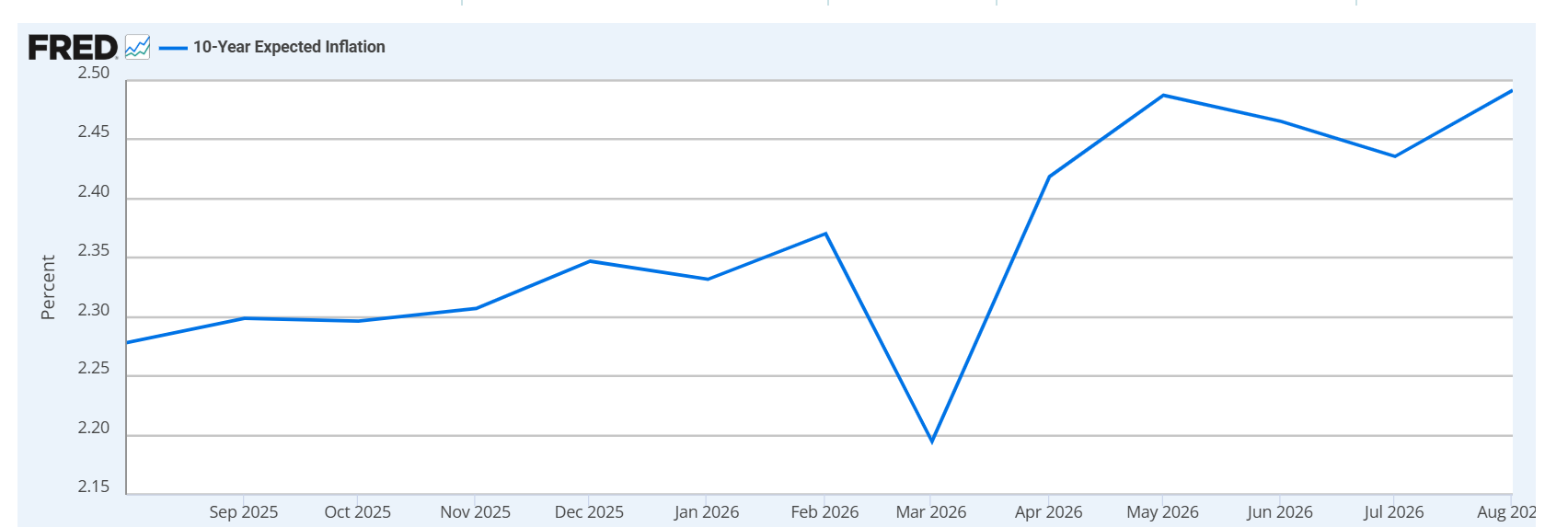
As seen below, 10-year expected inflation has been on an uptrend since August 2025. Though there was a relief in February 2026, it began to climb again in March 2026 and has been on an upward trend since then.
10-Year Expected Inflation, August 2025-August 2026
Source: Federal Reserve Bank of St. Louis
“The decades-long deflation driven by globalised, low-cost manufacturing is reversing,” according to Polaris Capital Management, an investment management firm. “Tariffs and reshoring are adding costs throughout the supply chain — the same forces that once exported lower prices are now exporting inflation. A return to the deflationary decade looks unlikely, further supporting the case for real rates and value equities.”
When inflation expectations rise, future earnings become less valuable, and investors prioritise stocks that can generate cash now so their earnings aren’t as heavily discounted. In other words, value stocks become more valuable than growth stocks when inflation expectations rise.
- Expectations of higher-for-longer interest rates: Polaris Capital Management also believes that the era of near-zero rates is over for the time being, given that the US government is already borrowing to pay interest on existing debt. Also, inflation staying above 2% makes it difficult to return to the near-zero rate era.
“Investors should expect sticky inflation above 2% and higher-for-longer rates,” they noted. “In this environment, capital gravitates toward value: higher dividend yields, strong balance sheets, and cash generation today rather than promises of tomorrow.”
When interest rates are low, capital availability is high, and investors can afford to bank on the future earnings of companies. However, when interest rates are high, capital availability is low, and investors become more disciplined. Thus, they focus on “tangible assets, strong balance sheets, and companies generating substantial free cash flow today,” according to Polaris Capital Management, rather than future cash flows or earnings.
- AI-capex boom: It is common knowledge that many blue-chip companies are investing massively in AI infrastructure.
Interestingly, this trend has supported asset-heavy companies, of which many are value stocks.
“The AI boom is often seen as a growth equity story,” noted AllianceBernstein. “Yet AI capital expenditure has also buoyed asset-heavy industries, such as semiconductor manufacturers and power infrastructure suppliers, which include many value-oriented companies.”
Also, J.P Morgan noted that the industrials and materials sectors have profited from the AI capex spree, which contributes to the recovery of value stocks.
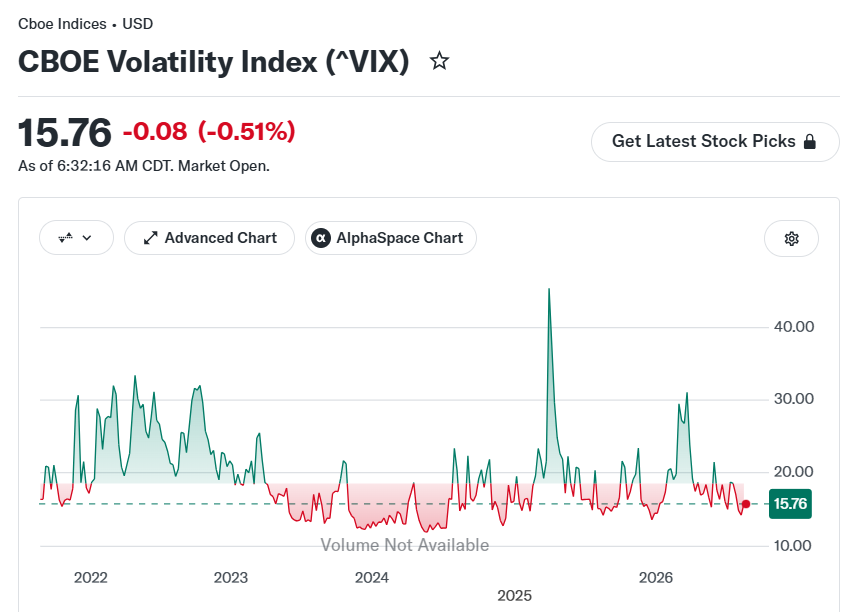
- Higher market volatility: Both economic and geopolitical factors have increased market volatility.
As seen below, the volatility index (VIX) surged in 2025. After moderating for a few months, it went up again around March, 2026. Though it is now moderating again, the factors driving uncertainty are still much alive.
CBOE Volatility Index, 2021-2026
Source: Yahoo Finance
Interestingly, value stocks tend to shine in moments of heightened uncertainty and volatility when quality and relative valuation become more important.
“Value investing also feels more relevant when rates and uncertainty are higher. A dollar of profit today becomes more attractive than a promise of profit many years from now,” according to Firdaus Syazwani, founder of Dollar Bureau, a personal finance education platform.
- Corporate governance improvements: Beyond the US, value stocks have experienced significant growth in China and Japan due to corporate governance improvements, according to AllianceBernstein.
2. Where are value investors finding opportunities in 2026?
Given that specific factors are driving the value investing rebound, investors are focusing their attention rather than just buying any undervalued stock that comes on their radar.
Based on the factors we have covered, below are the areas where value investors are finding opportunities in 2026:
- ‘Boring’ sectors in the US: As we have seen, macroeconomic (inflation, interest rates) and structural (AI capex spending) factors driving value stocks in the US favour certain industries: financials, industrials, materials, energy, infrastructure, healthcare, and utilities, among others.
“These areas may not have the most exciting narratives, but many have tangible assets, recurring demand and valuations that still leave room for mistakes (margin of safety),” according to Syazwani.
- International equities (Europe): However, value investors have been looking beyond the US to focus on international equities.
“International markets are inherently more value-oriented, with greater exposure to cyclicals — financials, materials, industrials — and far less concentration in high-multiple technology,” according to Polaris Capital Management. “Attractive valuations, a weaker dollar, and higher fiscal spending in Europe and select emerging markets create a compelling backdrop.”
Let’s start with Europe.
Value stocks in the UK and Europe at large have benefited from defence spending, demand for commercial aircraft, and a recovery in commodity prices.
Thus, opportunities abound in consumer staples, infrastructure, and defence stocks.
- International equities (Asia Pacific): Chinese industrials and financials are trading at deep discounts despite earnings recovery, supported by corporate governance improvements and shareholder-friendly policies.
Also, Japanese firms are increasing buybacks and dividends, making them attractive to value investors.
- Emerging markets equities: Recovery in commodity prices is also leading to renewed interest in commodity-linked equities in Latin America and some parts of Africa. Furthermore, government infrastructure programs are supporting long-term cash-flow visibility for infrastructure stocks.
3. Is the renewed interest in value investing sustainable?
We are back to the question we asked at the beginning: is value investing truly making a comeback, or is this just another temporary rotation?
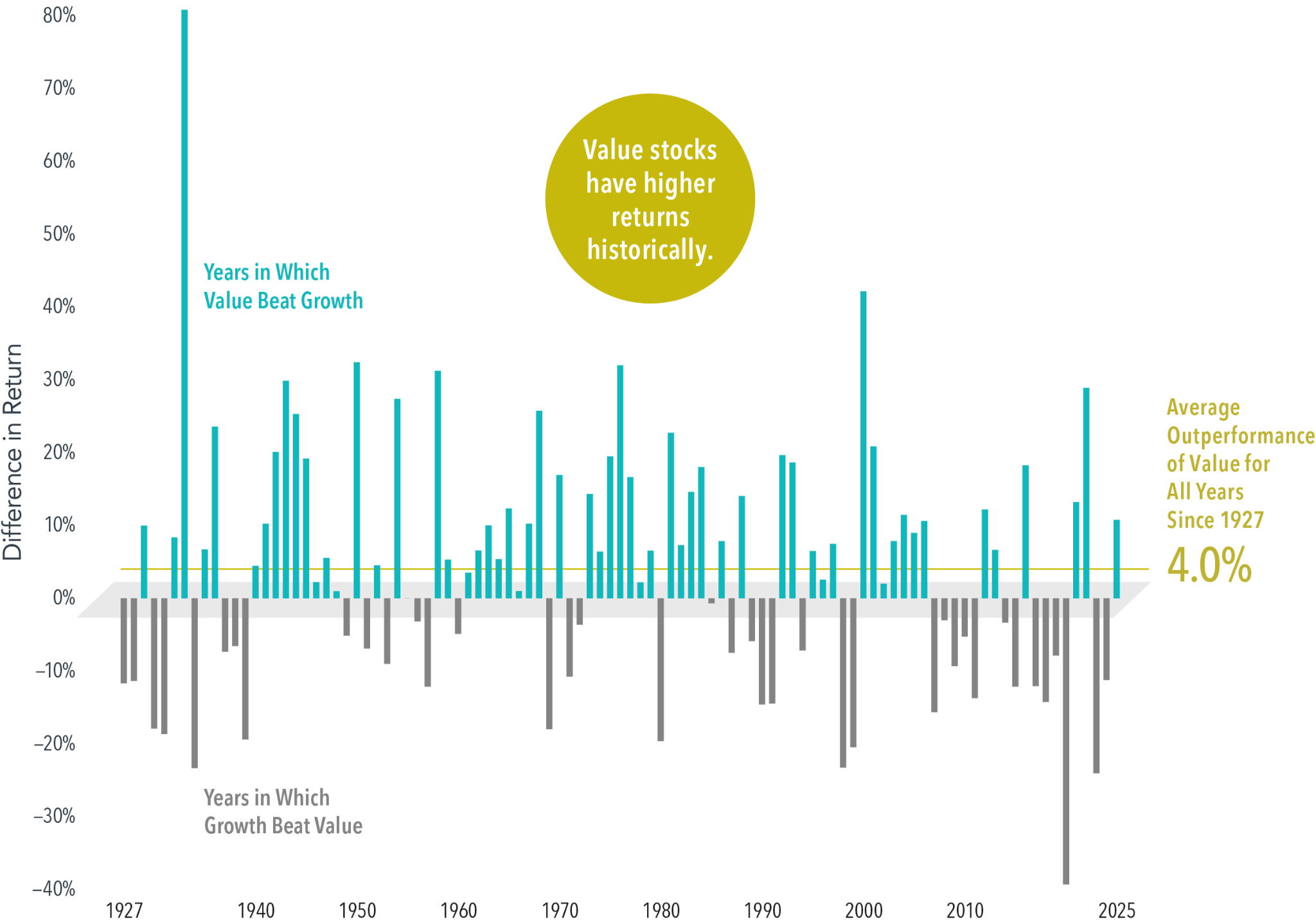
The first point to make is that value stocks have historically done better in the value stocks vs growth stocks debate.
As the chart shows, value stocks have more years of outperformance than growth stocks based on data from 1927 to 2025. Also, they have outperformed by an average of 4% over this period.
Value Stocks vs Growth Stocks: Performance Between 1927 and 2025
Source: Dimensional Fund Advisors
“Historically, value stocks have outperformed growth stocks in the US, often by a striking amount,” according to Dimensional Fund Advisors, a financial services company. “Data covering nearly a century backs up the notion that value stocks—those with lower relative prices—have higher expected returns.”
The point here is that value investing outperforming growth investing (even over a long period) is not an historical anomaly, and this fact should affect how we answer the question at hand.
However, it should be noted that renewed interest in value investing does not necessarily equal an outright rejection of growth investing.
“I do not think this is a permanent rejection of growth investing,” noted Syazwani. “Great growth companies will still deserve premium valuations. What is sustainable is the renewed demand for evidence: cash flow, pricing power, balance-sheet strength and reasonable entry prices.”
What then are the factors that will determine if value investing is here to stay or not? Below are the most important ones:
- Macroeconomic environment: If inflation continues to stay above 2% and inflation expectations stay high, then interest rates may stay higher for longer or at least refuse to come down.
This situation can be further worsened by continuous government borrowing (to pay interest on previous loans or for other purposes) via the crowding-out effect.
If this macroeconomic environment dominates, then interest in value stocks may be sustained for the foreseeable future.
- Strength of structural changes: The most important structural change right now is AI. We have seen that AI capex spending supports asset-heavy industries, which usually consist of value stocks.
If current spending patterns pause or stop, the stocks in these industries may suffer.
Interestingly, though, any AI bubble burst that dries up AI capex spending will likely reinforce the importance of value investing, as investors learn to focus on current tangibles over prospects.
Thus, the net effect on value investing might still be positive.
- Market uncertainty and volatility: Tariff policy and geopolitics are some of the greatest drivers of current market uncertainty.
There is still uncertainty about how the whole tariff business will play out, at least during Trump’s presidency. Also, though there have been talks about deals between the US and Iran, the Strait of Hormuz is still closed, and no one knows how everything will play out.
If uncertainty around these issues persists, market volatility may stay high, reinforcing the importance of value stocks.
- Investors’ risk tolerance: As said above, if investors have a lower risk appetite and prioritise capital discipline, value stocks will benefit. On the other hand, when risk appetite rises and capital becomes more available, growth stocks will thrive more.
Currently, investors are focused on risk, with many institutions measuring performance in terms of risk-adjusted returns rather than absolute returns.
Also, valuation discipline is a consistent feature in the current market as investors focus on quality.
“But the renewed focus on valuation discipline is sustainable because it solves a real problem in modern portfolios: too much exposure to the same expensive assumptions,” according to Syazwani.
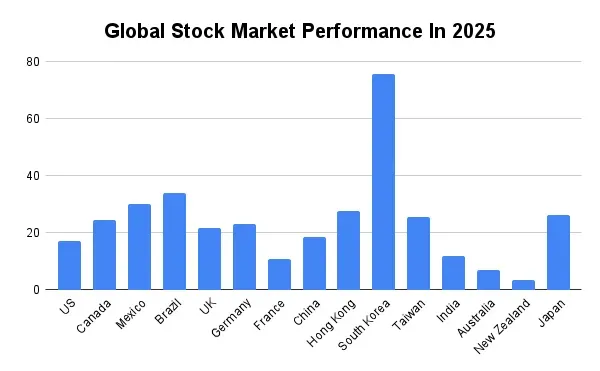
- Interest in international equities: International diversification is one of the best investment strategies for 2026.
Interestingly, this trend is driven both by concerns about the US economy and the impressive performance of international stock markets. As seen below, many international stock indices outperformed the S&P 500 Index in 2025.
Global Stock Market Performance in 2025
Source: Stockwits
If foreign equities continue to outperform, funds will flow to them as global investors pursue more diversified portfolios. Interestingly, as we have seen, international equities tend to have lower valuations compared to US stocks and are thus more supportive of value investing strategies.
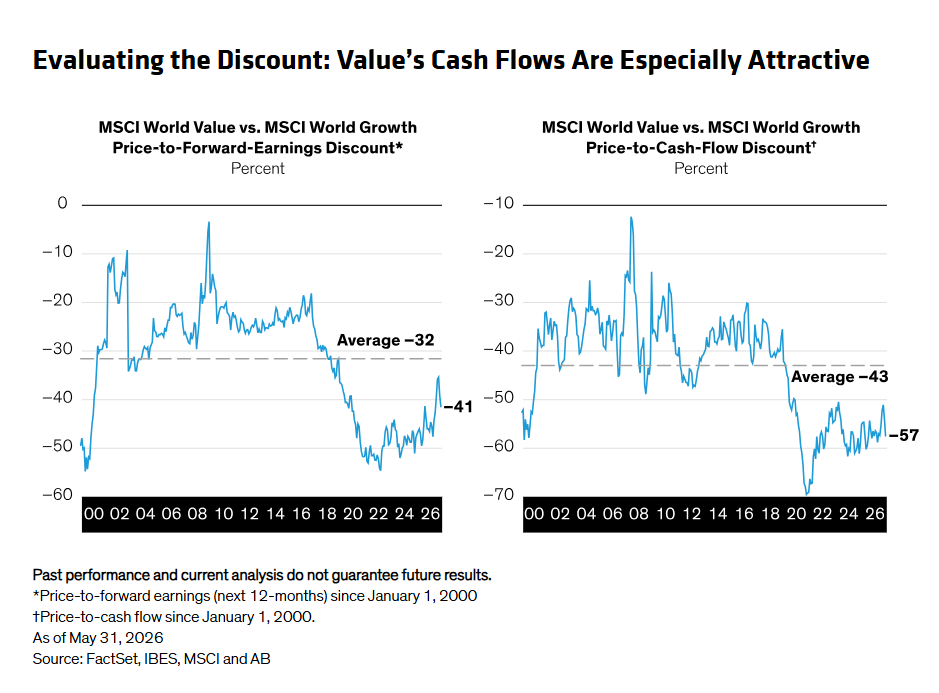
- Valuation gap: The current rebound has narrowed the valuation gap (measured by the price-to-earnings (p/e) ratio) between global value stocks and global growth stocks. Does this then mean that investors can no longer find good opportunities in value investing?
Not really.
As seen below, though the valuation gap measured by P/E ratio is only at a 9% discount from the historical average, it is at a double-digit (14%) discount when measured by the price-to-cash flow (P/CF) ratio.
Valuation Gap Between Value and Growth Strategies
Source: AllianceBernstein
When investors embrace a P/CF approach to finding valuation gaps, the value investing opportunity set widens.
“Many asset-light companies that wouldn’t have qualified as value stocks on P/B ratios in the past are attractive value investments based on their FCF projections,” according to AllianceBernstein. “As we see it, FCF metrics better capture a company’s ability to generate returns over time, helping investors identify businesses where market prices are undervalued.”
4. How should institutional investors approach value investing?
Now that we have evaluated the present and future of value investing, let’s close by explaining the approach that institutional investors should take when embracing this strategy.
- Value investing is quality plus price: As the CEO of Berkshire Hathaway, Warren Buffett did not go about buying any company with a low price-to-earnings ratio or price-to-book (p/b) ratio. Rather, as Buffett said, value investing as an investment philosophy is about buying wonderful companies (with durable competitive advantages) at fair prices.
A company must first be shown to be “wonderful” based on fundamental analysis of its financial statements (looking at factors such as free cash flow, return on invested capital, balance-sheet strength and leverage levels) before investors show any interest in comparing its intrinsic value with its market value. This is how to avoid the value trap.
Also, the principles outlined by Benjamin Graham and David Dodd in Security Analysis remain relevant: investors should assess the underlying value of a business rather than simply follow share prices.
“The value investing comeback becomes fragile if investors start buying low-quality companies only because they look cheap,” according to Syazwani. “Cheap stocks can get cheaper.”
- Focusing on metrics that truly matter: As we have seen, AllianceBernstein has argued that cash flow might be a better indicator of value than earnings.
What is their reasoning?
“Companies’ cash flows can’t be manipulated as easily as their reported earnings figures,” they noted. “In addition, a company’s cash-generating ability offers a clearer view of its underlying economic value. Strong cash flows are a sign of healthy business dynamics that enable a company to reinvest in its businesses, thereby enhancing earnings potential. By contrast, businesses with weak FCF may struggle to sustain earnings growth over time.”
Institutional investors buying individual value stocks should consider cash flow measures in their valuation models, whether as price multiples or in a discounted cash flow (DCF) valuation. And those who purchase value funds should choose managers that embrace a comprehensive approach to identifying value stocks.
- International diversification: International equities are outperforming US equities even though they are trading at lower valuations. Institutional investors embracing a value investing strategy cannot ignore international markets (developed and emerging).
- Align value investing with institutional mandates: Liability-driven investors can use value equities for inflation hedging, while active managers should emphasise bottom-up research and sector rotation. Also, passive allocators should focus on value ETFs or smart-beta indices that embrace value factor investing, but the kind that blend value, quality, and momentum factors.
Asset managers embracing a modern approach to value investing will benefit from conversations with other financial market experts, especially when evaluating asset quality.
At the cio investment club, we provide a platform where asset managers and all kinds of financial experts can exchange ideas and share insights about financial markets.
We also organise exclusive roundtables and investment breakfasts where experts can discuss trending investment topics and also collaborate on various exciting projects.
Do you want to become a member of an investment community that will help you better spot value opportunities in the market? Register now to become a part of the cio investment club.
Takeaways
- Higher rates, rising inflation expectations, weaker Magnificent 7 performance, and stronger earnings growth have created a more favourable environment for value stocks.
- Institutional investors are finding attractive valuations across Europe, Japan, China and emerging markets, particularly in financials, industrials, energy, infrastructure and materials.
- Persistent inflation, higher-for-longer rates, market uncertainty and continued demand for valuation discipline could support value investing over the longer term.
- Institutional investors should combine valuation with quality and embrace, use multi-factor models, and embrace international diversification.
This document is produced by Instaconnect Limited, trading as cio investment club, a company registered in England & Wales with registration number 15262951.
Instaconnect Limited is neither authorised nor regulated by the Financial Conduct Authority in the United Kingdom nor the Securities and Exchange Commission in the United States of America.
This document is a marketing documentation and is not intended to constitute an invitation or an inducement to engage in any investment activity. It is not intended to constitute investment advice and should not be relied upon as such. It is not intended and none of Instaconnect Limited, its holding companies or any of its or their associates, or any of the participants in the documentation, shall have any liability whatsoever for (a) investment advice; (b) a recommendation to enter into any transaction or strategy; (c) advice that a transaction or strategy is suitable or appropriate; (d) the primary basis for any investment decision; (e) a representation, warranty, guarantee with respect to the legal, accounting, tax or other implications of any transaction or strategy; or (f) to cause Instaconnect Limited to be an advisor or fiduciary of any recipient of this report or other third party.
The content and graphical illustrations contained in this document are provided for information purposes and should not be relied upon to form any investment decisions or to predict future performance. Instaconnect Limited recommends that recipients seek appropriate professional advice before making any investment decision. Although the information expressed is provided in good faith, Instaconnect Limited does not represent, warrant or guarantee that such information is accurate, complete or appropriate for your purposes and none of them shall be responsible for or have any liability to you for losses or damages (whether consequential, incidental or otherwise) arising in any way for errors or omissions in, or the use of or reliance upon the information contained in this document.
To the greatest extent permitted by law, we exclude all conditions and warranties that might otherwise be implied by law with respect to the document, whether by operation of law, statute or otherwise, including as to their accuracy, completeness, or fitness for purpose.
Instaconnect Limited and its logo are proprietary trademarks of Instaconnect Limited and are registered in the United Kingdom. Unauthorised copying of this document is prohibited.
© Copyright Instaconnect Limited 2026